Printing Cost Estimator for Businesses: How Jobs Are Priced
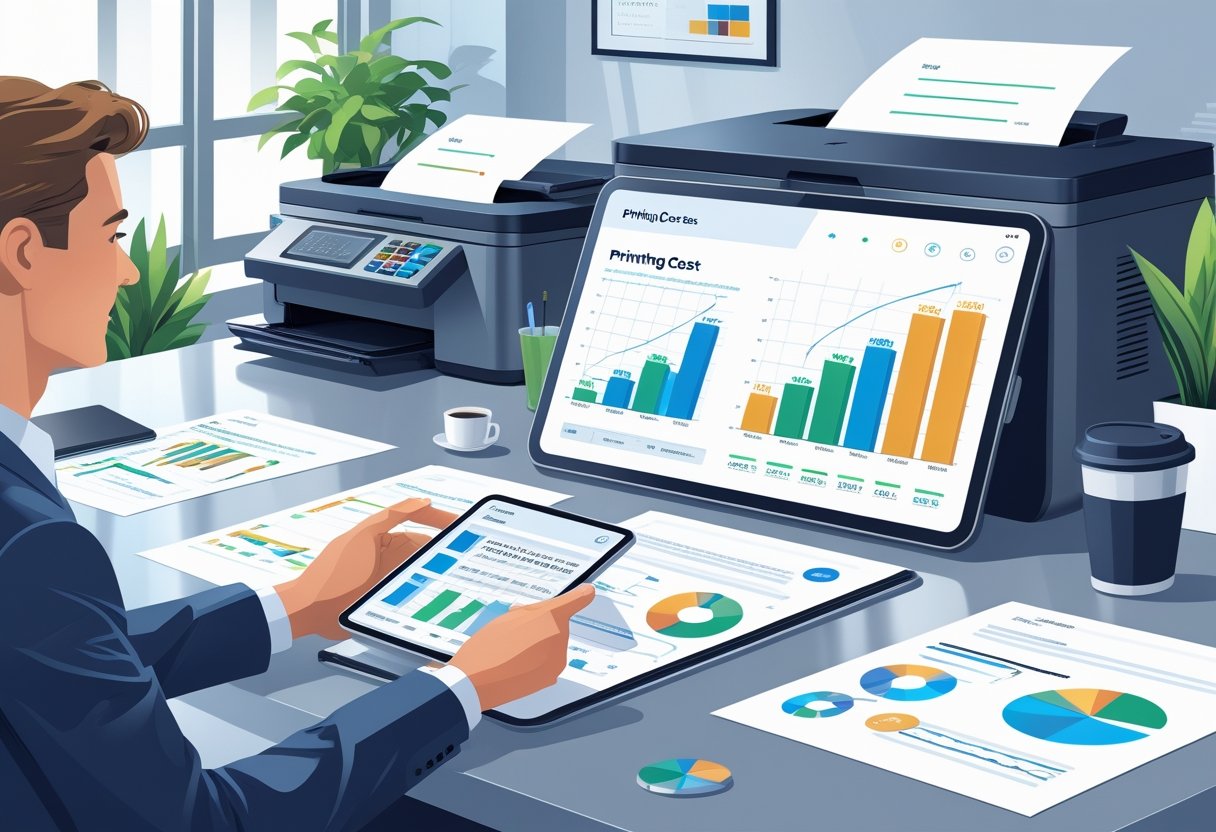
A printing cost estimator is a model that converts a job's specifications into a price by pricing five things in sequence: the substrate, the makeready and waste, the press time, the finishing, and the overhead and margin the shop needs to stay open. Every commercial print quote you have ever received was built that way, whether the shop used estimating software, a spreadsheet, or 30 years of instinct.
Most articles about printing costs answer a different question. They tell you what a toner cartridge yields and how to cut office printing waste. That is print consumption, not print estimating, and it will not help you read a $4,800 quote for 10,000 saddle-stitched booklets or explain to your CFO why the same job came back at $3,900 from one shop and $6,200 from another.
This guide covers the estimating side. You will see the actual arithmetic a printing cost estimator runs, where offset and digital cross over, what changes when the job also has to mail, and exactly which nine specifications you need to hand a printer to get an estimate you can trust. If you would rather skip the math and get a real number, request a custom quote or call 863-687-6945.
What a Printing Cost Estimator Actually Calculates
Printing costing and estimating is not one calculation. It is five costs stacked in order, and the order matters because each step changes the inputs to the next one.
The Five Cost Buckets in Every Print Estimate
Substrate. The paper or board, priced by the sheet, not by the finished piece. This is usually the single largest swing in a quote and the one buyers underestimate most.
Makeready and waste. Every press run burns sheets before the first sellable copy comes off. On digital that is a handful of sheets. On offset it is plates, ink balance, and registration, which is why offset carries a much higher fixed cost per job.
Press time. Machine hours at the shop's hourly rate, driven by sheet count, sides, and color coverage.
Finishing and bindery. Cutting, folding, scoring, stitching, perfect binding, laminating, drilling. Finishing routinely accounts for more of a quote than buyers expect, and it is where "just add a fold" turns into a real number.
Overhead and margin. Rent, equipment, insurance, prepress labor, and the shop's profit. Applied as a rate on top of the direct costs.
A printing cost estimator that skips any one of these produces a number that is wrong in a predictable direction. Free online calculators almost always skip makeready and finishing, which is why their output tends to run low on short runs and long runs both.
Why Two Shops Quote the Same Job Differently
The specifications are identical, so the gap has to come from somewhere else. It almost always comes from one of four places.
The first is imposition. A shop that can fit six pieces on a press sheet where another fits four will quote roughly a third less on substrate, plus a smaller reduction in press time, for the same job. The second is equipment fit: a job that runs efficiently on a digital press can be genuinely expensive to set up on offset, and the reverse is true at volume.
The third is finishing capability. Work a shop can run in-line costs less than work it has to handle as a second pass. The fourth is what is bundled. A quote that excludes prepress, proofing, or freight is not cheaper, it is incomplete, and the difference surfaces as change orders later.
How to Calculate Printing Costs: The Estimator's Math
Here is the sequence a print estimator runs. The example below uses 5,000 two-sided brochures on 100 lb gloss text, 8.5 by 11 inches flat, trimmed and folded to an 8.5 by 3.67 inch trifold. Both dimensions are stated on purpose, for the reason the nine-spec checklist below gets to.
Step 1: Convert the Job Into Press Sheets
Nothing gets priced until the estimator knows how many press sheets the job consumes. That means deciding the parent sheet size, laying out how many finished pieces fit on it (the "n-up" count), and dividing.
Fit two 8.5 by 11 inch pieces on a 12 by 18 inch sheet and 5,000 finished pieces becomes 2,500 press sheets. Move to a parent sheet twice that size, fit four up, and it becomes 1,250. This single decision sets both the sheet count and the press hours, which is why it is step one and not an afterthought.
Step 2: Add Makeready and Waste
Add the sheets consumed before and during the run. A practical planning figure is 3 to 5 percent overage on a digital run and a fixed makeready allowance plus 5 to 8 percent on offset, because offset has to bring plates, ink, and water into balance before it holds color.
On our 2,500-sheet digital example, a 4 percent allowance adds 100 sheets. Budget 2,600 sheets, not 2,500.
Step 3: Price the Substrate
Paper is priced per hundredweight or per thousand sheets, then divided down to a per-sheet cost. The estimator multiplies that per-sheet cost by the sheet count from step two.
Substrate is where quotes move most, because a text weight and a cover weight of the same size can differ by more than double per sheet. This is also the first place to look for savings: dropping one weight class often changes the price materially and changes how the piece feels very little.
Carrying the example forward with an illustrative paper cost of $0.14 per 12 by 18 inch sheet, 2,600 sheets comes to $364 in substrate. (Every rate in this walkthrough is illustrative and rounded so the arithmetic is followable. Your shop's real rates will differ, and MPA's own rates come back on a quote, not from a blog post.)
Step 4: Add Press Time, Finishing, and Bindery
Press time is booked press-line hours (setup plus run) times the shop rate. Finishing gets priced per operation, and each operation is its own setup plus its own run rate.
In the running example, the 2,600-sheet duplex run books roughly 2.5 press-line hours once setup, proofing, and operator handling are counted alongside run time, which at an illustrative $100 per hour is $250. The press itself prints far faster than the booking implies; setup and handling dominate the hours. Trimming and folding as two separate operations, each carrying setup plus run time, adds about $125. Direct cost so far: $364 substrate plus $250 press plus $125 finishing, or $739.
| Finishing operation | How it is priced | What buyers forget |
|---|---|---|
| Trimming and cutting | Per lift, plus setup | Extra trims for bleed on all four sides |
| Folding | Per thousand, plus setup | Heavy stocks need scoring first or they crack |
| Scoring | Per thousand, plus setup | Required above roughly 100 lb text |
| Saddle stitching | Per book, plus setup | Page count must be divisible by four |
| Perfect binding | Per book, plus setup | Has a spine minimum and a higher setup floor |
| Laminating | Per side, per square area | Two-sided costs roughly double one-sided |
| Drilling and padding | Per thousand holes or pads | Registration on drilled work adds a pass |
Step 5: Apply Overhead and Margin
Overhead is not a guess. A shop divides its annual fixed costs (rent, equipment payments, insurance, prepress and administrative labor) by its budgeted productive hours to get a burden rate, then applies that rate to the hours your job consumes. Margin goes on after that.
This is why the same job moves week to week. A shop running below its budgeted hours has to recover the same fixed costs across fewer jobs, and a shop running at capacity does not. Neither is dishonest, and it is the reason a quote you sat on for a month is worth re-requesting rather than assuming.
Applying an illustrative 35 percent combined burden and margin to the $739 of direct cost above gives roughly $998, or about $0.20 per piece at 5,000.
Now change one input. Running 4-up on a parent sheet twice the size halves the press-sheet count to 1,250, or 1,300 once the same 4 percent waste allowance is added, but a sheet twice the area costs roughly twice as much, so substrate stays near $364. Press time falls, though not by half: setup, proofing, and handling are unchanged and only run time halves, so the booking goes from 2.5 press-line hours to roughly 1.9, or $190. Direct cost drops to $679, the total to roughly $917, and the price to about $0.18 per piece. Imposition buys back run time, not paper and not setup, which is why the savings are real but smaller than buyers expect.
| Estimate line | Illustrative amount | Where it came from |
|---|---|---|
| Substrate | $364 | 2,600 sheets at $0.14 per sheet |
| Makeready and waste | Included above | 100 of the 2,600 sheets |
| Press time | $250 | 2.5 press-line hours (setup + run) at $100 per hour |
| Finishing (trim and fold) | $125 | Two operations, setup plus run |
| Direct cost subtotal | $739 | Sum of the above |
| Overhead and margin | $259 | 35 percent applied to direct cost |
| Estimated total | About $998 | About $0.20 per piece at 5,000 |
Run this math on your own specification
Our press-sheet estimator applies the same five buckets to any flat size, parent sheet, stock, and quantity you enter, and it shows the digital and offset sides together so you can see where the crossover lands for your job. The illustrative rates are editable, so you can substitute your own paper and press numbers and keep the arithmetic consistent with the worked example above.
Open the Press-Sheet Estimator →What the Quantity Curve Actually Looks Like
Because makeready, prepress, and finishing setup are fixed per job, the per-piece price falls fast at first and then flattens. The table below shows illustrative postcard printing ranges that follow the same curve every commercial print job follows; exact MPA pricing depends on the full spec and comes back on a quote.
| Quantity | Typical printing cost per piece | Why it lands there |
|---|---|---|
| 500 to 1,000 | About $0.25 to $0.35 | Setup is spread over very few pieces |
| 2,500 | About $0.18 to $0.22 | The common small business volume |
| 5,000 to 10,000 | About $0.12 to $0.18 | Setup spread thin, press runs efficiently |
| 25,000 and up | About $0.08 to $0.12 | Fully amortized setup, sustained press run |
Note that these sit below the $0.20 the folded brochure above landed at, and they should: a flat postcard on card stock takes one pass and no bindery, while a folded text-weight brochure adds a fold and a second finishing setup. Compare curves within a format, never across them.
Two levers move that number: quantity, which spreads fixed cost, and size, which consumes more sheet and more ink. Our full postcard cost guide breaks the same curve down by format, and our free MPA tools cover the adjacent math. For flat sheet and bound work, see our commercial printing services page.
Want this run against your actual specifications rather than a table?
Talk to Estimating →How to Calculate Offset Printing Cost Compared to Digital
The question underneath "how to calculate offset printing cost" is almost always a crossover question: at what quantity does offset stop being expensive and start being cheap? The answer follows directly from the five buckets above.
Where the Crossover Sits
Offset carries a high fixed cost and a low variable cost. Plates, makeready, and ink balance have to be paid before the first good sheet, and after that each additional sheet is inexpensive.
Digital inverts that. There is effectively no plate cost and minimal makeready, but each impression carries a per-click charge that does not fall with volume.
Offset cost per piece falls as quantity rises while digital stays flat, so the two cost curves cross at a break-even quantity. For the running example above, an 8.5 by 11 inch two-sided piece imposed 2-up on a 12 by 18 inch sheet at an illustrative $0.14 per sheet and $100 per press-line hour, the two sides land within a fraction of a cent of each other at about 11,000 pieces. Below that quantity the plate and makeready charge is still spread too thin for offset to win; above it offset pulls ahead and keeps widening. The crossover is a property of the specification rather than a universal number, and it moves in predictable directions: heavier ink coverage and larger sheets push it lower, while versioning, personalization, and short deadlines push it higher or eliminate offset from consideration entirely.
Running the Comparison Yourself
Calculate the offset side as (plates plus makeready plus press time plus substrate) divided by quantity. Calculate the digital side as (click charge times impressions plus substrate plus minimal setup) divided by quantity. Compare the per-piece results at your actual quantity, not at a generic one.
Two adjustments matter. If the job has versions, count each version as its own offset makeready but as zero additional digital setup, because variable data printing changes content without stopping the press. And if the job reprints on a schedule, evaluate the annual quantity rather than the single run.
Our guide to the types of printing on paper covers how each method behaves on quality and turnaround, which is the other half of the decision. MPA handles both digital and offset work, so we size the method to the job rather than to a single machine. Our digital printing services page covers short-run and versioned work specifically.
What Changes When the Print Job Also Mails
A printing cost estimator that stops at the loading dock is only estimating part of the job. For mailed work, three more line items land on the quote, and postage is the largest of them.
Postage Is a Pass-Through, Not a Markup
Postage is set by USPS, not by your printer. At MPA it is billed at the exact rate with no markup, which means the honest way to read a print and mail quote is to separate postage from everything else and compare the rest.
Presort depth is what moves postage. Marketing Mail Letter Presort Mixed pricing is $0.467 per piece, and mail that qualifies for tighter presort tiers pays less than that. The published figures live in USPS Notice 123 (Price List), and our 2026 USPS postage rates page tracks the current schedule. For local saturation work without a mailing list, EDDM prices differently again, and our EDDM cost calculator will price that side of the job for you. To model what the campaign returns rather than what it costs, use the direct mail ROI calculator.
Data Processing Is Cheap and Non-Optional
Address hygiene is a few cents per piece spread across the run, and skipping it costs far more than running it. On a typical business-to-consumer list, roughly 94 percent of records pass address validation through CASS and DPV, and of the records that pass, we see about 98.5 percent deliverability after National Change of Address hygiene. The standard behind that validation step is published by USPS as its CASS certification program, which defines how address-matching software is tested and scored before a mailer may claim automation prices.
Run the arithmetic on a 10,000 piece drop and the case makes itself: every undeliverable piece carries full printing cost and full postage and produces nothing. Our mailing list and data services page covers list sourcing and hygiene in detail.
Mail Preparation and Entry
Inserting, addressing, tabbing, tray and pallet preparation, and USPS entry are priced per thousand. MPA holds a USPS Business Mail Entry Unit permit and presents mail on our own permit at the Lakeland BMEU, so no consolidator is accumulating a truckload before your mail moves. Our print and mail services page covers the full workflow.
How to Get an Accurate Print Estimate
Most slow or wrong estimates trace back to an incomplete request. Estimators cannot price what they have not been told, so they either ask (which costs you a day) or assume (which costs you accuracy).
The Nine Specifications Every Estimator Needs
- Flat size and finished size. Both, not one. A piece that folds has two dimensions that matter.
- Quantity, including any additional quantities you want priced. Ask for the curve, not one point.
- Number of pages or sides. For bound work, the exact page count.
- Ink coverage. Full color both sides, full color one side, or black only.
- Stock. Weight, finish, and whether coated or uncoated. If you do not know, say what the piece has to do.
- Bleed. Whether artwork runs to the trimmed edge, which changes imposition.
- Finishing. Every fold, score, stitch, bind, laminate, drill, or perforation.
- Turnaround. Your in-hand date, not "as soon as possible."
- Delivery or mailing. Ship to one address, ship to many, or mail. If it mails, say the mail class and whether you are supplying the list.
Send those nine and you can get an estimate for a print job online or by phone in hours instead of days. Leave three of them out and you will get a range, a caveat, and a callback.
Reading the Estimate You Get Back
Check that the estimate names the stock rather than saying "house stock." Check whether prepress and proofing are included or billed separately. Check whether freight is in the number. Check the quantity break structure, because if additional quantities are not shown you cannot see where your own volume sits on the curve.
A print estimate is a good-faith price based on stated specifications. A quote is a commitment. If your specifications are still moving, ask for an estimate and expect it to change when they settle. That distinction prevents most of the friction that shows up later in a job.
Print Estimating Software and In-House Cost Control
If you run a print shop rather than buy print, the estimating question is different: how much structure do you need around your own numbers?
A spreadsheet model is genuinely sufficient when the product mix is narrow and repeatable. Build it around press sheets rather than finished pieces, keep substrate costs in one table you update when paper prices move, and keep makeready and finishing setup as explicit line items rather than folding them into an hourly rate. A spreadsheet that hides fixed costs will quote short runs too low every time.
Dedicated estimating platforms start earning their cost around three practical thresholds: more than one person writing quotes, more than roughly 20 quotes a week, or more than a handful of distinct product types. Below all three, a spreadsheet and one experienced estimator will be faster. Above any two of them, the failure mode is not bad math, it is the same job priced two different ways by two different people in the same week.
For buyers, there is a useful tell in this. Ask a printer how long a quote is good for. A shop with a disciplined estimating process will give you a firm window, usually 30 days, because it knows its own input costs. A shop that cannot answer is quoting from memory, and memory reprices itself after you have committed.
Why Businesses Bring Print Estimating to MPA
MPA has been printing and mailing from Lakeland, Florida since 1989, which is 35+ years of estimating jobs like yours, and we serve businesses in all 50 states from a single Lakeland facility. More than 700 lifetime business customers have run work through this building, and we hold 5.0 stars across 100+ verified Google reviews.
Four things about our estimates are worth knowing before you ask for one.
Print and mail are estimated together. Because the same team runs the press, the inserters, and the mail entry, the estimate reflects the real workflow instead of three vendors guessing at each other's handoffs. Nothing is quoted twice and nothing falls between quotes.
Postage is billed at the exact USPS rate with no markup. You can compare our number against any other quote line by line, because the postage line is the same number USPS publishes.
Compliance is already in the price. MPA is SOC 2 Type 2 audited and HIPAA compliant for protected health information, which matters if your mail carries regulated data. That is not an add-on line item.
Production is in house. Xerox Iridesse and Xerox Versant production presses handle color work, a Xerox Nuvera handles high volume black and white, and we cover offset work as well, so the estimate reflects the method that actually suits the job. One roof, one team, all 50 states.
Send us the nine specifications above and we will return a real number. Request a custom quote or call 863-687-6945 and ask for estimating.
Frequently Asked Questions
What is a printing cost estimator?
A printing cost estimator is a model that turns a job's specifications into a price by calculating press sheets, substrate, makeready and waste, press time, finishing, and then applying overhead and margin. It can be estimating software, a spreadsheet, or an experienced estimator working from a rate card. What makes it accurate is not the tool, it is whether all five cost layers are included: free online calculators typically price paper and clicks only, which is why their numbers run low on short runs, on anything folded or bound, and on anything that mails.
How do businesses calculate the cost of printing services?
Start by converting the finished quantity into press sheets using the imposition (how many pieces fit on a press sheet), then add a makeready and waste allowance of roughly 3 to 5 percent on digital or more on offset. Price the substrate per sheet, add press hours at the shop rate, price each finishing operation as its own setup plus run rate, then apply overhead and margin. Divide the total by the finished quantity to get cost per piece.
How do you calculate offset printing cost?
Offset cost is (plates plus makeready plus press time plus substrate) divided by the quantity. Because plates and makeready are fixed per job, the per piece cost falls steeply as quantity rises, which is why offset is expensive on short runs and inexpensive at volume. Compare that per piece result against the digital calculation at your actual quantity, since the crossover point moves with ink coverage, sheet size, and whether the job has versions.
What information do I need to get a print estimate?
Nine items: flat and finished size, quantity plus any additional quantities you want priced, page or side count, ink coverage, stock weight and finish, whether the artwork bleeds, every finishing operation, your in-hand date, and how the job ships or mails. Supplying all nine typically gets an estimate back in hours rather than days.
Can I get an estimate for a print job online?
Yes. Send the nine specifications through our contact form and we will return a real estimate rather than a calculator output. Online instant calculators work well for standardized products in standard sizes, but they price from a fixed template, so anything with unusual finishing, a non-standard size, or a mailing component needs a human estimator to be accurate. For the mail side specifically, our EDDM cost calculator gives an immediate number.
Why do print estimates from different shops vary so much?
Four reasons account for nearly all of it: imposition (how many pieces each shop fits on a press sheet), equipment fit (whether the job suits their presses), finishing capability (in-line versus a second pass), and scope (whether prepress, proofing, and freight are included). Before assuming one shop is cheaper, confirm both estimates cover the same work.
What is the difference between a print estimate and a print quote?
An estimate is a good-faith price based on the specifications as stated, and it can change if those specifications change. A quote is a firm commitment to a price for a defined scope. Ask for an estimate while specifications are still moving and a quote once they are locked.
How much does commercial printing cost per piece?
It depends almost entirely on quantity and size, because fixed setup costs spread across the run. As a reference point, commercial postcard printing typically runs roughly $0.25 to $0.35 per piece at 500 to 1,000, about $0.18 to $0.22 at 2,500, about $0.12 to $0.18 at 5,000 to 10,000, and about $0.08 to $0.12 at 25,000 and up. Exact MPA pricing depends on the full spec and comes back on a quote. Bound and large format work follows the same curve with different absolute numbers.
"NCOA before every drop. We catch 6 to 9 percent of records moved on a typical commercial list, sometimes 12 percent on lists older than 18 months. That's deliverability you're paying postage on. Skipping NCOA to save the per-thousand fee is the most expensive false economy in the business."
Alec Boye, President, Mail Processing Associates