Cleaning Service Marketing: Fill Nearby Neighborhoods by Mail
Cleaning service marketing is the work of getting a residential or commercial cleaning business in front of the households and offices inside its drive time, then converting them into recurring accounts. It is different from most local marketing because the product is a subscription, not a one-time sale. A single cleaning client who stays two years is worth thousands of dollars in revenue, so the question is never just what a lead costs. The question is what a lead costs in a neighborhood you can actually service profitably.
That distinction changes the whole plan. Most advice for cleaning businesses starts with a channel list: build a website, claim your Google Business Profile, ask for referrals, run ads. All of that belongs in the plan. None of it answers the question that decides whether a cleaning company grows or just gets busier, which is how you concentrate clients tightly enough that your crews stop burning the day in the truck.
The channel that concentrates clients best is also the one most cleaning marketing advice skips: mail that reaches every home on a carrier route you choose.
This guide is about that channel. It covers the carrier-route mail program that builds route density for a cleaning business, the 2026 USPS postage behind it, the printed formats that work, and the fundamentals that have to be in place for any of it to convert. It is deliberately not an all-channel survey.
Ready to reach a specific neighborhood? Use the free MPA EDDM route planner to see how many homes sit on each carrier route in your service area, or call 863-687-6945 for a quote.
What Makes Cleaning Service Marketing Different
The revenue is recurring. A house cleaning client on a biweekly plan generates revenue every two weeks for as long as they stay. That makes the acceptable cost to acquire a customer far higher than a one-time service business could tolerate, and it makes retention part of the marketing budget rather than an afterthought.
The service area is a drive time, not a city. A crew that spends 40 minutes between jobs is losing an appointment slot every day. Marketing that generates scattered clients across a metro area produces a schedule that looks full and a P&L that does not work.
The buying trigger is unpredictable. People hire cleaners after a move, a new baby, a health change, a schedule change, or a hosting deadline. You usually cannot catch that moment with search alone, because most of those people were not searching last week and will not be searching next week. You catch it by being the name they already recognize when the moment arrives.
That last point is why repetition inside a fixed geography beats one-time reach across a wide one. The households on the streets your crews already drive are worth contacting more than once.
Route Density Beats Reach
Route density is the number of clients you serve per carrier route. It decides how many jobs a crew can finish in a day, which is why it belongs next to cost per lead in any cleaning company's numbers.
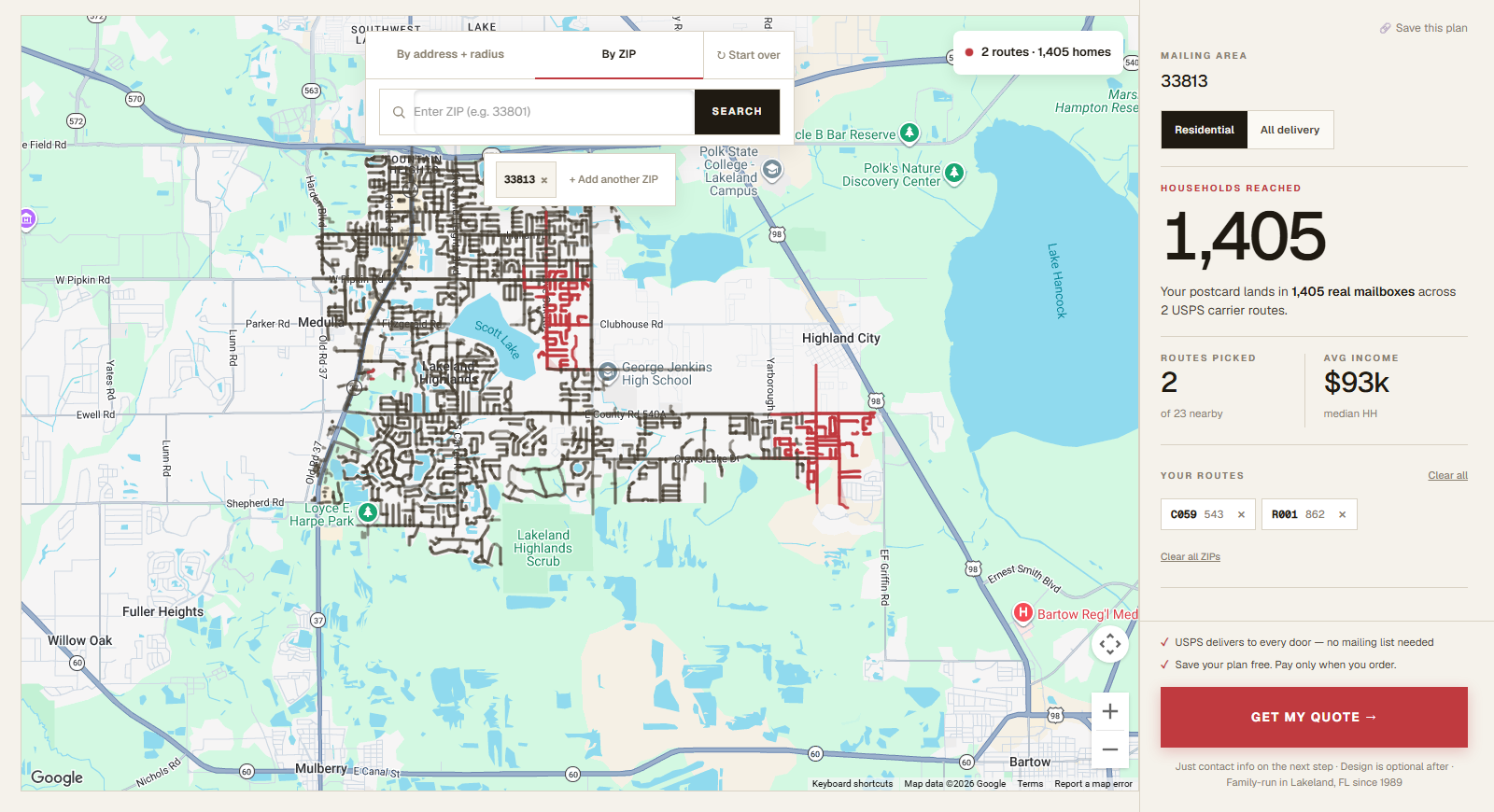
Two cleaning companies can both sign 40 clients in a quarter. The one whose clients are spread across six ZIP codes runs fewer jobs per crew per day, pays more in fuel and windshield time, and reschedules more often when a job runs long. The one whose clients cluster in three neighborhoods fits more appointments into the same eight hours and can add a crew sooner.
So the first strategic decision in cleaning service marketing is not which channel to use. It is which neighborhoods you want to own, chosen by three filters:
- Drive time. Draw a realistic radius around your base, or around your densest existing cluster.
- Household profile. Income, household size, and age track closely with who buys recurring cleaning, and they are the same attributes USPS lets you filter carrier routes on.
- Existing footprint. The streets where you already have clients are the cheapest place to add more, because your vehicles are visible there and neighbors talk.
Pick three target neighborhoods and rank them. Everything below aims at those three, and the first mail drop goes to the top one only.
Why Direct Mail Fits a Cleaning Business
Direct mail is the only major channel that lets you select a geography first and reach essentially everyone inside it. Search ads target intent, social ads target interests, and both scatter across your radius. Mail lets you say "these carrier routes, every home" and hit that.
The response math holds up. The ANA Response Rate Report puts direct mail at roughly 9% average response for business-to-consumer house lists and about 5% on prospect lists, against approximately 1% for email marketing. USPS Mail Moments Review 2024 found that about 90% of households open direct mail.
Read those figures for what they are. They measure response to a targeted list of named people, and a response is an inquiry, not a signed recurring client. EDDM is saturation mail: it reaches every address on a route, including the renters, the retirees who clean their own homes, and the households that already have a cleaner. Plan a saturation drop at a fraction of a percent in booked clients and let lifetime value carry the math. The worked example below uses 0.2%, which is well under the list-based figures above and is the number to budget against.
Mail also solves the timing problem. A postcard on the counter is still there when the trigger event happens three weeks later.
How EDDM Works for a Cleaning Business
Every Door Direct Mail (EDDM) is a USPS program that delivers a mail piece to every active address on postal carrier routes you select, with no mailing list required. You choose routes on a map, print pieces that meet the size rules, and the Postal Service delivers to every door on those routes.
You are not trying to reach one named homeowner. You are trying to become the recognized cleaning company on a specific set of streets.
The mechanics in short:
- Select carrier routes covering your target neighborhoods. Routes can be filtered by median household income, age, and household size, with business addresses included or excluded, so you can drop routes that do not fit your client profile.
- Choose a format that meets EDDM size rules. Pieces must be larger than a standard letter and no larger than 12 by 15 inches.
- Print and prepare the pieces in USPS-required bundles with the correct indicia in place of a stamp.
- Drop the mail at the right postal facility, or hand the whole job to a mailing service that handles printing, preparation, and the drop for you.
The minimum is one full carrier route (or 200 pieces), which keeps a first test affordable for a small operator. Read the full mechanics in our EDDM guide.
What EDDM Postage Costs in 2026
Postage is the predictable part of the budget. These are current USPS figures per USPS Notice 123 (Price List) effective July 12, 2026.
| Mail option | 2026 postage per piece | Mailing list needed | Best use for a cleaner |
|---|---|---|---|
| EDDM Retail | $0.260 | No | Saturating target neighborhoods |
| EDDM, destination delivery unit (DDU) entry | $0.259 | No | Permit drops entered at the delivering post office |
| Marketing Mail letter, Mixed tier | $0.467 | Yes | Targeting named prospects or past clients |
| First-Class postcard, retail stamp | $0.65 | Yes | Small one-off sends, no presort required |
Postage is not the whole cost. Bundling, transport, and the drop at the postal facility are quoted on top of it, and printing is quoted separately based on quantity, size, and paper. For the USPS postage detail behind these figures, see our EDDM postage rates page, and for the print side see how much postcards cost. A written quote is what prices bundling, the drop, and printing against your actual routes and quantity.
Run the math before committing. A 2,000-piece drop costs $520 in postage at the EDDM Retail rate of $0.260 per piece, before printing. If that drop books four biweekly clients at a $150 ticket (a 0.2% booking rate, deliberately conservative), each generates about $5,850 in revenue over 18 months, or roughly $23,400 for the four. That is revenue, not profit, so apply your own labor and supply margin before judging the return.
Even a single booked client returns the postage many times over, which is why route selection matters more than shaving pennies off the piece. Our ROI calculator runs this with your actual ticket size.
Cleaning Service Postcards and Mailed Flyers
Postcards are the workhorse. They need no envelope, they get read without being opened, and they hold an offer, a photo, and a phone number comfortably. Cleaning service postcards in a jumbo size give you room for a before-and-after image and a coupon without crowding.
Flyers work when you need more space to explain a service menu, commercial capabilities, or a move-out cleaning checklist. One important clarification: house cleaning flyers in this plan are printed and mailed through USPS carrier routes, not walked door to door. Mailed delivery is trackable, legal on every street, and does not put anyone on a porch.
Both formats can be printed and mailed as a single job. Splitting printing and mailing between two vendors is where mail dates slip, because neither vendor owns the deadline.
Cleaning Business Advertising Channels Compared
Read the geographic-control column first. For a cleaning business it predicts route density better than the other three.
| Channel | Strength | Weakness | Geographic control |
|---|---|---|---|
| Google Business Profile and local SEO | Free to run and captures people already searching, which converts fastest of any channel | Takes months to rank, and total volume is capped by how many people search in your area each month | Moderate |
| Referral program | Closes at the highest rate of any channel and tends to cluster on the same streets, which raises route density for free | You cannot schedule it or scale it on demand, so it will not fill a new territory | High but passive |
| Paid search | Reaches buyers at the moment of intent and can be switched on the same day | Cost per click is bid up in most metros, and spend stops producing the moment you pause it | Moderate |
| Lead marketplaces | Produces lead volume immediately with no setup or creative work | Leads are sold to several companies at once, buyers shop on price, and you build no brand of your own | Low |
| Neighborhood social apps | Recommendations carry real trust and land in exactly the neighborhoods you want | Cannot be scheduled or scaled, and a single complaint thread can undo months of goodwill | High but passive |
| EDDM direct mail | You choose the exact carrier routes and reach every active address on them, no list required | Every drop costs the same whether anyone responds or not, recognition needs two or three drops, and results take weeks rather than days to read | Highest |
The pattern is worth naming. The channels with the best geographic control are the referral program, neighborhood word of mouth, and carrier-route mail. Two of those three you cannot schedule. Mail is the one you can.
The Fundamentals Mail Cannot Replace
Mail concentrates a route. It does not close the people it reaches. Every one of them checks you out before they call, and these are the assets they check.
Your Google Business Profile is the real homepage. Most people who get your postcard will search your company name before dialing. Complete every field, set the service area to the neighborhoods you actually cover rather than the whole metro, and add photos of your own crews and finished work instead of stock images. Post the same offer that is on the mail piece so the two match when someone cross-checks.
Reviews are the conversion asset, and they decay. Recency matters more than the lifetime total, because a prospect reading a five-star average whose newest review is fourteen months old assumes the business changed. Ask the day the job finishes, while the house is clean and the client is standing in it. Send one link, not a paragraph of instructions. When a bad review lands, reply once, briefly, factually, and offer to fix it, because the reply is written for the next reader rather than the angry one.
The website has one job: make booking obvious. A cleaning prospect wants a price range, the service area, what a standard clean includes, and a way to book without a phone call. Put the phone number in the header on mobile. If you run a promo code on the mail piece, give it a page of its own so the traffic is attributable.
The referral program should be written down. An informal "tell your friends" produces nothing repeatable. A credit toward the next clean for any neighbor who books is simple enough to explain in one sentence, and it compounds route density because a client's neighbors are on the same carrier route you already mailed.
None of this replaces the route strategy. It is what makes the route strategy convert instead of leak.
House Cleaning Flyers That Earn a Callback
A mailed piece has only a few seconds between the mailbox and the counter. What survives that trip is not clever writing. It is a clear offer and an obvious reason to trust you.
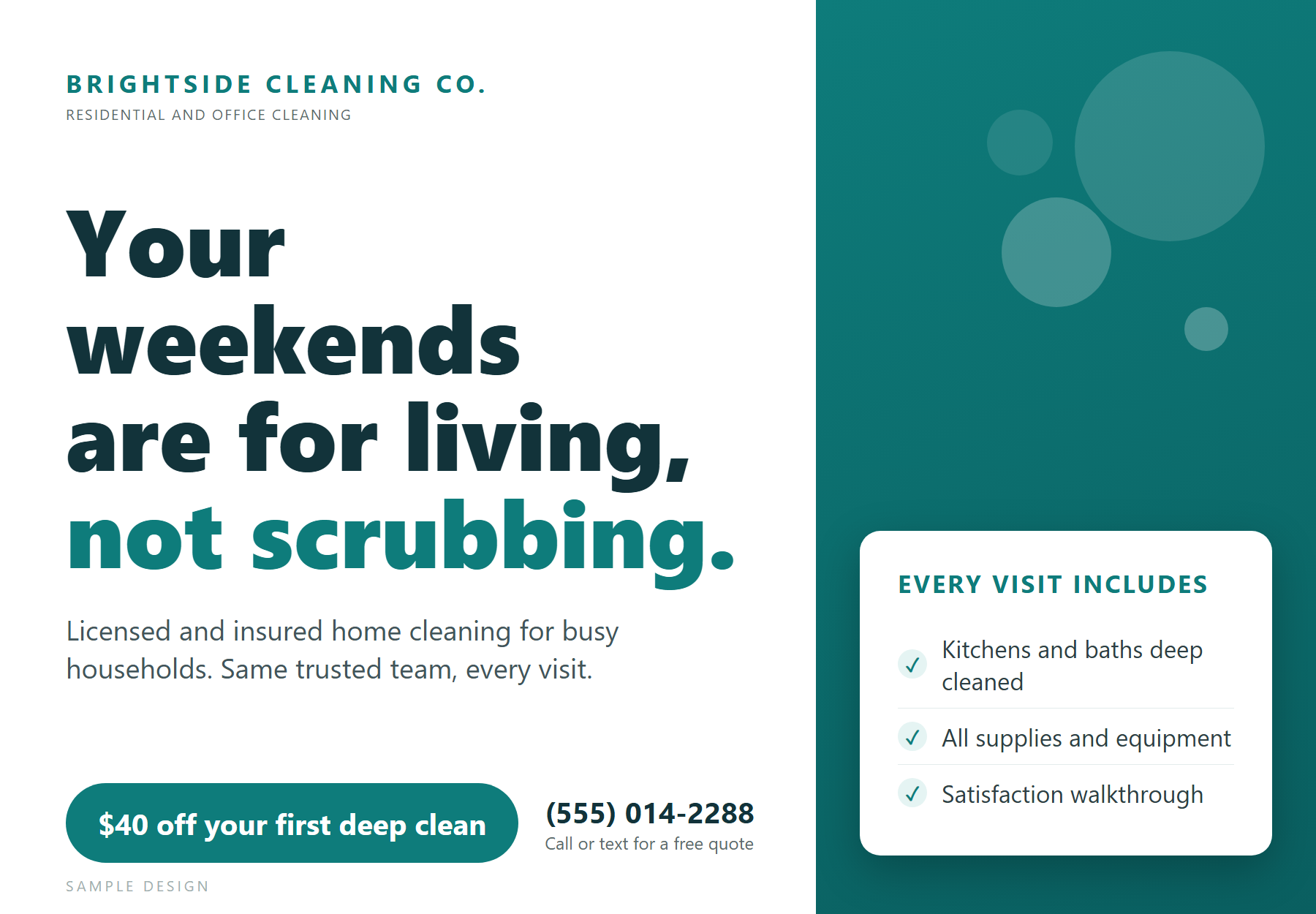
Put these on the front:
- One offer, stated plainly. "$49 off your first clean" beats "affordable, reliable service."
- Proof. A star rating, a review count, or a before-and-after photo of real work.
- The neighborhood name. "Now serving Oakbridge and Highland Park" outperforms a generic city reference, because it signals you are already nearby.
- A phone number and a booking link. Some people call, some tap. Give both.
Put these on the back:
- What is included in a standard clean, in a short list.
- Insurance and background-check language, which is the top unspoken objection in residential cleaning.
- A deadline. An offer with no expiration gets set down and forgotten.
One production note. Send print-ready files if you have them, and if you do not, our file check tool will tell you whether a file will print correctly before it goes to press. Getting the file right is what keeps a mail date from slipping.
The Offer Does the Heavy Lifting
Artwork and route selection get a piece read. The offer decides whether the reader picks up the phone, and it is the cheapest variable to change between drops: a new offer costs a reprint, while a new route costs a whole test cycle and starts recognition over from zero.
A weak offer asks for a big commitment from a stranger. A strong offer lowers the risk of the first transaction and builds the recurring relationship afterward. Three that consistently work for residential cleaning:
- A discounted first clean tied to a recurring plan. The discount only applies if they book biweekly or monthly. This filters out one-time deep-clean shoppers.
- A flat-rate introductory offer for a defined scope. Removing pricing uncertainty is worth more than the dollars discounted.
- A move-in or move-out special. These buyers have a hard deadline and far less price sensitivity.
For commercial accounts, the offer changes. Businesses do not respond to coupons. They respond to a free walkthrough and a written quote, because the buyer needs something to show a manager.
A 90-Day Cleaning Service Marketing Plan
This assumes a small operator with a limited budget and no in-house marketer.
Days 1 to 30: Pick the Ground and Get the First Drop Out
Choose three target neighborhoods using the drive time, household profile, and existing footprint filters. Confirm the carrier routes that cover them and check the household counts.
Fix the fundamentals in parallel. Claim and complete your Google Business Profile, get your service area right, and start asking every satisfied client for a review the day the job is finished.
Then mail. Send your first EDDM drop to the single best neighborhood, not to all three. One route done twice will teach you more than three routes done once.
Days 31 to 60: Repeat and Measure
Mail the same neighborhood a second time, roughly three to four weeks after the first drop. Recognition compounds, and the second piece almost always performs better than the first because the first one did the introducing.
Start tracking. Assign a dedicated phone number or a unique promo code to the mail campaign so calls are attributable. Ask every caller how they heard about you and write it down.
Launch the referral program now, while your first mail-sourced clients are new and enthusiastic. A credit toward their next clean for any neighbor who books is the simplest structure that works.
Days 61 to 90: Concentrate or Expand
Look at the numbers. If neighborhood one produced clients at an acceptable cost, mail it a third time and add neighborhood two. If it did not, change the offer before you change the neighborhood, because the offer is the variable that fails most often.
This is also the point to add a second format. A larger mailed flyer covering your full service menu works well to a route that has already seen two postcards.
How to Measure Cleaning Service Marketing
Four numbers carry the whole picture: cost per booked client, client lifetime value, route density, and retention. They are also the numbers that run every trade in the home services direct mail playbook.
- Cost per booked client, by channel. Not cost per lead. Leads that never book are not the goal.
- Client lifetime value, calculated as average ticket times visits per year times average years retained. This sets your acceptable acquisition cost.
- Route density, measured as clients per carrier route. Rising density means the strategy is working.
- Retention rate at 3, 6, and 12 months. Marketing that fills a bucket with a hole in it is wasted spend.
Track mail specifically with a dedicated phone number, a promo code, or a landing page used only on the printed piece. Give a mail campaign a fair window too. Response arrives over several weeks, not several days, because people hold the piece until the need appears.
Mistakes That Waste a Cleaning Marketing Budget
Mailing once and calling it a test. A single drop measures recognition you have not built yet. Plan a minimum of two, ideally three, into the same routes.
Spreading the budget across eight channels. A small budget divided eight ways produces eight results too small to read. Pick two channels and fund them properly.
Targeting too wide an area. A radius twice your realistic drive time wastes most of the spend and creates a schedule your crews cannot run.
Leading with price alone. The cheapest cleaner in a market attracts the least loyal clients. Lead with trust signals and a specific offer.
No tracking. Without a dedicated number or code, you will credit whichever channel the client happens to remember, which is usually the wrong one.
Ignoring existing clients. A mailed reminder to past and current clients about add-on services costs a fraction of new-client acquisition. For list-based sends like this, Marketing Mail letters at the Mixed tier run $0.467 per piece.
Frequently Asked Questions
How much does cleaning service marketing cost for a small business?
Size it from the drop rather than from a percentage of revenue. A 2,000-piece EDDM drop into one neighborhood is $520 in USPS postage at $0.260 per piece, with printing, bundling, and the drop quoted on top of that. What makes that affordable is the value behind a single booking: a biweekly client at a $150 ticket who stays 18 months generates about $5,850 in revenue, so one client covers the postage on that drop many times over. Our EDDM postage rates page has the USPS postage detail, and a written quote prices the rest against your actual route count and quantity.
Does direct mail still work for cleaning companies?
Yes, and the geographic control is the reason. The ANA Response Rate Report puts direct mail response around 9% for business-to-consumer house lists and about 5% for prospect lists, compared with roughly 1% for email. Those are list-based figures, though, and they do not describe EDDM: saturation mail reaches an entire carrier route including households that will never hire a cleaner, so it performs well below them. That is why the budgeting example on this page uses 0.2% booked clients instead. For a recurring-revenue service where one client generates thousands in revenue over their lifetime, even that lower rate supports the spend.
What is the minimum EDDM order for a cleaning business?
One full carrier route (or 200 pieces). Carrier routes are not a fixed size, though, so "one route" is not a fixed piece count: confirm the household count on the specific routes you select before you set a budget, because two adjacent routes can differ substantially. The route planner shows the count per route.
Are house cleaning flyers delivered door to door?
Not through this approach. The flyers are printed and mailed through USPS carrier routes, so every active address on the route receives one through the mailbox. That avoids the legal and practical problems of placing material on doors and porches, and it gives you a documented mail date.
Postcards or flyers for a cleaning business?
Postcards for offers and repetition, since they are read without being opened and cost less to mail. Larger flyers when you need to explain a full service menu, commercial capabilities, or a detailed move-out checklist. One sizing note specific to EDDM: the piece has to be larger than a standard letter, so the smallest practical postcard for this channel is bigger than the 4x6 card most people picture, and the jumbo sizes cost the same postage as the smaller qualifying sizes. Many cleaning companies use postcards for the first two drops and a flyer for the third.
How long before a mail campaign produces calls?
Expect the first calls within a week of in-home delivery and a tail that runs several weeks after. Cleaning is a trigger-driven purchase, so a share of responses arrives whenever the household's need appears rather than the day the mail lands. Most EDDM jobs are produced in 3 to 5 business days once artwork and routes are confirmed.
How do I choose which neighborhoods to mail?
Start with drive time from your base, then weight toward streets where you already have clients. USPS lets you filter carrier routes on median household income, age, and household size, and include or exclude business addresses during route selection, so you can drop routes that do not match your client profile before spending a dollar.
Does this work for commercial cleaning companies?
The strategy holds but the execution changes. Carrier routes can be selected to include business addresses, which reaches office parks and retail strips near your base. The ANA Response Rate Report puts business-to-business direct mail response at about 4.4%, lower than consumer house lists but against a much larger contract value. Swap the coupon for a free walkthrough and a written quote, because a facilities manager needs a document to justify the switch internally.
Get Your Cleaning Service Campaign in the Mail
If you do one thing from this guide, make it this: pick your single best neighborhood, mail it twice about a month apart, and put a dedicated phone number on the piece so you can count what it returns. That test costs one route and answers the question that every other channel decision depends on, which is whether you can buy clients profitably on streets your crews already drive.
Mail Processing Associates has run direct mail for 35+ years from a single Lakeland, Florida production facility, serving more than 700 lifetime business customers across all 50 states, with 5.0 stars across 100+ verified Google reviews. We print your pieces, prepare them to USPS standards, and drop them at the postal facility as one job, so nothing gets lost between a printer and a mail house.
Plan your routes with the free EDDM route planner, review our EDDM services, or call 863-687-6945 for a quote on your first neighborhood drop.
Alec Boye, President, Mail Processing Associates
"The single most-overlooked variable in direct-mail performance isn't creative or list quality. It's USPS handoff timing. Get that wrong and your response window collapses by two weeks."
Alec Boye, President, Mail Processing Associates