Daycare Advertising With EDDM and Direct Mail
Daycare advertising is the set of paid and owned channels a childcare center uses to put itself in front of local parents who are actively shopping for care. For most centers the constraint is not awareness in general. It is awareness inside a tight radius, among households that have a child in the right age band right now.
That is why mail earns its place in a daycare marketing budget. A postcard that lands in a kitchen on a Tuesday reaches both parents, stays on the counter through the decision window, and does not vanish when a monthly ad budget runs out.
This guide covers the mail side of daycare advertising: EDDM saturation and targeted direct mail around your center. The two are not interchangeable, and the choice is not really a marketing decision. The size of the card you design decides which postage tier you are allowed to buy, and that one constraint can move a 5,000-piece budget by thousands of dollars, which is why the postal rules below come before the creative advice.
Mail Processing Associates has run print and mail programs from a single Lakeland, Florida production facility since 1989, serving businesses in all 50 states. We print, address, and presort in house and induct the mail at the Lakeland BMEU, so a childcare campaign moves through one team instead of three vendors.
Ready to price a drop? Request a custom quote or call 863-687-6945.
What Does Daycare Advertising Cost by Mail?
For a childcare center, the mail side of daycare advertising prices out in two parts, and the card size decides which postage tier is available. EDDM Retail postage is $0.260 per piece and covers every household on the carrier routes you select, while a targeted list mailed as a Marketing Mail letter at the presort Mixed tier is $0.467 per piece. Printing a full-color 6.25x9 card runs $0.15 to $0.23 per piece depending on quantity and stock, separate from postage and mail preparation. A center that prints 5,000 of those cards and drops them itself as EDDM Retail pays about $1,300 in postage plus roughly $950 in print.
Where Mail Fits in the Daycare Advertising Mix
No single channel fills a center. Most enrolled families touch several before they call, so the useful question is not which channel wins but which job each one does. Five matter for childcare, and each one falls down somewhere.
| Channel | The job it does | Where it falls down |
|---|---|---|
| Google Business Profile and reviews | Captures parents already searching for care nearby and supplies the social proof they check first | Only reaches parents who are already looking, and review volume builds slowly |
| Paid search | Buys the top of the results page for high-intent queries | Every center in town bids the same few words, so cost per click climbs and stops the day you pause |
| Paid social | Builds familiarity and collects tour requests through in-app lead forms | Reaches parents who were not shopping yet, so inquiry quality varies and creative burns out |
| Parent referrals | Produces the highest-converting inquiries at the lowest cost | Volume is capped by how many families you already have, so it cannot fill a new room on its own |
| Direct mail | Reaches every household in a chosen radius whether or not they are searching yet, at a cost you know before you commit | Slower to read results than a click report, and a drop cannot be edited once it is in the mail |
That table is not a ranking. The right mix depends on how much of your radius already knows you exist. A center with a full waitlist and strong reviews should protect referrals and search. A center opening a new room, entering a new neighborhood, or competing against a center that just opened nearby has a coverage problem, and coverage is the specific thing mail buys.
Fix these three before you spend on any channel
Advertising multiplies whatever your intake process already does. If the process leaks, more advertising just leaks faster, so these come first.
Answer inquiries the same hour. In childcare the center that responds first very often wins the tour, because a parent researching care is usually contacting several centers in one sitting. Decide who owns the inbox and the voicemail during operating hours, and give that person permission to book a tour without checking with anyone.
Finish your Google Business Profile. Accurate hours, current photographs of the actual rooms rather than stock imagery, the age groups you serve, and a steady trickle of reviews. Ask two families a month at pickup, when they are already happy, instead of running a review push once a year.
Publish a tuition range. Many centers hide pricing to protect the tour, but it mostly generates inquiries from families who were never going to enroll and burns your staff's time. A published range filters for fit before the call and signals the transparency parents are already looking for.
None of that requires a budget. It requires a decision and about a week. Once those three hold, the mail below is what puts your name in front of families who have not started searching yet.
Why Direct Mail Still Works for Daycare Advertising
Childcare is a proximity purchase. Parents pick a center they can reach on the commute, so your real market is a handful of neighborhoods rather than a metro area, and buying that map directly is the thing mail does better than any auction-based channel.
Two properties of the format matter as much as the geography. A childcare decision usually involves two adults and often a grandparent who handles pickup, and a card on the kitchen counter reaches all of them where an impression on one phone does not. Parents also rarely enroll the day they start looking, so a piece that survives on the refrigerator through a two or three week tour cycle keeps working the whole time.
What mail does not do
Mail will not fix a weak offer, a stale website, or a phone that goes to voicemail at 10 a.m. It generates inquiries. Everything after the inquiry is your enrollment process, and that process is usually where centers lose families rather than at the top of the funnel.
Published benchmarks help set expectations. The ANA Response Rate Report puts B2C house lists near a 9% average response rate and cold prospect lists near a 5% average response rate. Those figures count inquiries on list-based mail. A saturation drop measured by signed enrollment agreements is a stricter test and will read lower.
What Daycare Advertising Costs in 2026
Budget in two separate parts: postage and print. They are priced by different parties, they move independently, and centers that blend them into one number lose the ability to see which one is driving the total.
Postage
Postage is set by USPS and does not vary by printer. These are the three rows that decide a childcare mailing, per USPS Notice 123 (Price List) effective July 12, 2026.
| USPS tier | Postage per piece | Piece it applies to | Best fit for a center |
|---|---|---|---|
| EDDM Retail | $0.260 | Flat-size card, including 6.25x9 and 6.25x11 | Blanket coverage of the neighborhoods around one location |
| Marketing Mail letter, presort Mixed | $0.467 | Letter-size card only, up to 6.125 by 11.5 inches | A targeted list mailed on a smaller card |
| Marketing Mail flat, presort | Quoted per job | Oversized card, including 6.25x9 and 6.25x11 | A targeted list mailed on the same oversized card you would use for EDDM |
Read that third row carefully, because it is the line most childcare budgets get wrong. The Marketing Mail letter rate of $0.467 does not apply to a 6.25x9 or a 6.25x11 card. Those sizes mail as flats, and a targeted flat costs several times what the same card costs to mail by EDDM. We quote Marketing Mail flats per job rather than publish a rate, because the price turns on the piece passing flat machinability, which a rigid oversized card can fail. Choosing a targeted list does not just add a list cost, it can change the postage tier underneath your whole campaign.
That leaves you two coherent plans rather than four. Mail the oversized card by EDDM and accept that some homes have no young children, or mail a targeted list on a letter-size card and accept the smaller canvas. Mailing an oversized card to a targeted list is the expensive combination, and it is worth pricing before you design around it.
That letter row is the Mixed presort tier most targeted lists actually qualify for. Tighter presort tiers exist and cost less per piece, but they require enough volume concentrated in the same postal areas, which a single-location center rarely has. Presorted Marketing Mail also carries a 200-piece minimum per mailing, so a targeted drop has to clear that floor before any presort rate applies.
Three constraints before you build a budget. EDDM Retail is capped at 5,000 pieces per ZIP code per day, so a drop that puts more than 5,000 pieces into a single ZIP either spans multiple days or moves to permit entry. Spreading the same volume across several ZIP codes relieves that cap rather than triggering it. The floor runs the other way: the smallest EDDM drop is one full carrier route (or 200 pieces), so a single-neighborhood test drop is still legal.
Print is the part you control. Quantity moves it more than anything else, because setup is fixed and spreads across the run. The table below is per piece, for full color on coated stock, and it excludes postage and mail preparation.
| Quantity | 6.25x9 card, print per piece | 6.25x11 jumbo, print per piece | Notes |
|---|---|---|---|
| 2,500 | $0.20 to $0.23 | $0.25 to $0.29 | Typical single-center radius drop |
| 5,000 | $0.17 to $0.21 | $0.21 to $0.26 | Volume break begins |
| 10,000 | $0.15 to $0.18 | $0.18 to $0.23 | Best per piece print economics |
The jumbo runs a few cents higher at every quantity and carries the same postage as the standard size, so the decision between them is a design and impact question rather than a postal one.
A worked example: a do-it-yourself EDDM Retail drop
Take a center that prints 5,000 cards at 6.25x9, priced at the middle of the 5,000 band, and drops them itself as EDDM Retail at the Post Office serving the routes around its building. A drop this size fits in one day as long as no single ZIP exceeds 5,000 pieces.
- EDDM Retail postage: 5,000 x $0.260 = $1,300
- Print: 5,000 x $0.19 = $950
- Those two lines together: $2,250
Treat that as the do-it-yourself total, not a quote. It covers the USPS EDDM Retail postage and the printing, and it leaves out the bundling, banding, transport, and postal paperwork that turn a stack of cards into a mailing USPS will accept. Our EDDM postage rates page carries the USPS postage detail behind these figures, and a written quote prices the preparation against your actual route count.
The point of the exercise is the shape of the math, not the total. Divide your quoted campaign total by your annual tuition per child, and you have the number of enrollments the drop has to produce to pay for itself. Run that division before you approve the mailing, not after the results come in.
You can model variations on quantity and response with our direct mail ROI calculator.
Choosing a Format for Childcare Mailers
Three formats cover almost every childcare campaign. The choice is mostly a function of how much you need to explain.
Oversized postcards are the default. They carry a photo, a headline, an offer, and a call to action without asking anyone to open anything. For a center whose pitch is "we have openings in the toddler room, come see us," a card is enough.
Letters in envelopes make sense for a targeted list where the message is personal, such as a new-mover welcome or a re-enrollment note to a family whose child aged out of one room. Envelopes cost more to print, and they move to higher postage once inserts push the piece past the letter weight break, but they signal a different kind of message.
Folded self-mailers sit in between and suit centers with more to say: a curriculum summary, staff credentials, daily schedule, and tuition tiers in one piece. They work when you are asking a parent to compare you against a specific competitor across town.
Size matters more than it looks
EDDM Retail requires a flat-size piece. The piece has to exceed 6.125 inches in height, 10.5 inches in length, or 0.25 inches in thickness (11.5 inches in length under a USPS permit) to qualify. That is why our EDDM cards are 6.25x9 and 6.25x11: the 6.25 inch height clears the flat threshold with margin.
A standard 6x9 card does not qualify for EDDM and has to mail another way, usually as a Marketing Mail letter on a targeted list. Centers that design a piece before checking the size requirement often discover this after the artwork is approved, which is an expensive point to find out.
We print postcards in every common size. See postcard printing for stocks, coatings, and finishing options.
Targeting the Right Households Around Your Center
Saturation by carrier route
USPS Every Door Direct Mail sends to every active address on the postal carrier routes you pick. No mailing list is required, EDDM postage is well below the targeted option in this guide, and coverage inside the chosen routes is complete.
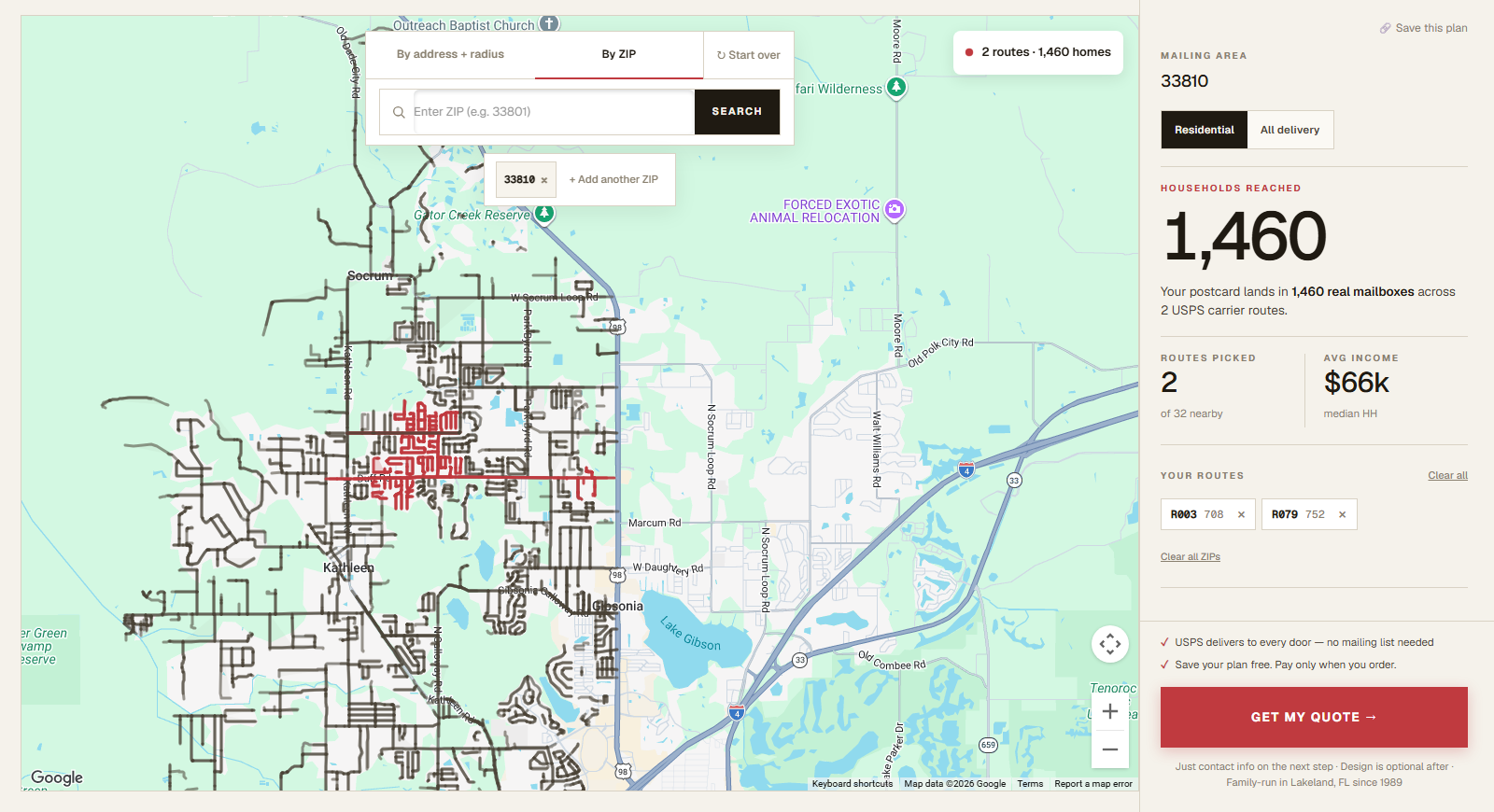
USPS publishes route-level data you can select against, including average age, average income, average household size, and residential versus business counts. For a childcare center, average household size and average age are the two that matter, because together they proxy for the presence of young children better than anything else available at the route level.
The tradeoff is real: you pay to reach every home on the route, including the retired couple and the college rental. At EDDM postage prices that waste is cheap, which is exactly why saturation works for a proximity business.
Our free EDDM route planner shows the routes around an address with their household counts, so you can see what a given radius actually costs before committing.
Targeted lists
A targeted list flips the math. You pay more per piece and per name, and in exchange you mail only households that match criteria you choose, including presence of children and the age of those children.
This is the better option in two cases. The first is a premium or specialized program, such as a Montessori or bilingual preschool, where the parent profile is narrower than a neighborhood. The second is new movers, which is the strongest single list a childcare center can buy.
New movers are worth calling out. A family that just relocated has no incumbent provider, no established routine, and an urgent problem to solve. Mailing new movers monthly keeps a center in front of exactly the households whose need is immediate rather than hypothetical.
You can scope a list by geography and household criteria with our mailing list builder, or talk to us about a standing monthly new-mover program.
Radius, not city
Set your footprint by drive time rather than by city limits. Most centers draw the large majority of families from a small ring around the building or along the commute corridor into the nearest employment center.
Pull the addresses of your current families and map them before you buy anything. That map is the most useful targeting document you own, and it usually shows a tighter and more lopsided pattern than owners expect.
Timing a Daycare Marketing Campaign
The largest window is late summer. Families settle care arrangements as the school year starts, so a drop landing in late July or early August catches parents mid-decision. January is second, driven by new-year schedule changes and parents returning from leave. March through April matters for centers that pre-register for fall.
Plan backward from the in-home date. Most EDDM jobs take three to five business days in production before USPS delivery time is added on top, so a piece that needs to land the first week of August should be approved in mid-July, not the last week of the month.
New-mover mail is the exception to seasonality. It runs continuously, because families relocate year round, and it is the one program that keeps producing inquiries in the slow months between the enrollment peaks.
Offers and Creative That Get Parents to Tour
The mail piece has one job: book a tour. Everything on it should serve that.

Make the offer concrete. "Waived registration fee for August starts" beats "affordable rates." A specific, dated offer gives a parent a reason to act this week rather than bookmark you.
Lead with the constraint parents feel. Openings are the scarce thing in most markets. "Two openings in the toddler room" outperforms any general quality claim, because it is specific, it is checkable, and it creates urgency without manufacturing it.
Show the room, not a stock photo. Parents are evaluating a place they will leave their child. A real photograph of your actual space and staff does more work than any adjective.
Put licensing and credentials on the piece. State license number, accreditation, staff certifications, and years in operation are trust signals that a parent is going to look for anyway. Making them easy to find shortens the evaluation.
Give two ways to respond. A phone number for the parent who wants to talk and a QR code to a tour booking page for the parent who is reading at 9 p.m. after bedtime. Different parents convert on different channels.
One caution on artwork: send us a print-ready file built to the size you have chosen. Our free file check tool will flag bleed, resolution, and color problems before the job goes to press, which is a much cheaper place to catch them.
Measuring Daycare Advertising Results
Most centers cannot say what their last mailing produced, which is why the mailing after it gets cut. Attribution here is not hard, it just has to be set up before the drop.
- Use a dedicated phone number that rings the front desk, so calls from the mailer are countable.
- Print a unique promo code tied to the offer and require it at registration.
- Use a dedicated landing page and QR code rather than sending traffic to your home page.
- Ask every inquiry how they heard about you and write the answer down the same day.
- Measure by carrier route so you learn which neighborhoods are worth mailing again.
Track two numbers, not one. Inquiries tell you whether the mail worked. Enrollments tell you whether your tour and follow-up worked. When inquiries are healthy and enrollments are not, the problem is downstream of the mailbox, and mailing more will not fix it.
Give the campaign a fair window. Mail response arrives over weeks rather than hours, and childcare decisions are slower than most consumer purchases because a tour has to be scheduled around a working parent's calendar.
How MPA Runs Childcare Direct Mail Campaigns
We handle the campaign end to end from one facility, which matters most when a date is fixed and an enrollment window is closing.
Data comes first. Lists run through CASS validation and NCOA processing so you are not paying postage to reach families who moved. On a typical consumer list, approximately 94% of records pass address validation (CASS/DPV), and we see 98.5% deliverability after NCOA hygiene on the records that pass.
Printing runs on our Xerox Iridesse and Versant presses in Lakeland. Addressing, presorting, and mail preparation happen in the same building, and we presort in house and induct mail at the USPS BMEU under our own permit. A center does not need to open its own permit to reach presort or EDDM postage tiers.
You get one point of contact from file to mailbox, a written quote that separates print from postage, and a production schedule tied to the in-home date you need. MPA holds 5.0 stars across 100+ verified Google reviews.
Centers that outgrow a single-route drop usually move to a standing monthly schedule, which our EDDM services and mass mailing services pages cover in full.
Ready to fill your next enrollment window? Get a free quote or call 863-687-6945. Tell us your address and the number of homes you want to reach, and we will price the drop.
Frequently Asked Questions
How much does daycare advertising cost per piece?
Budget postage and print separately. USPS postage runs $0.260 per piece for EDDM Retail, and Marketing Mail at the presort Mixed tier runs $0.467 per piece for letter-size mail on a targeted list, per USPS Notice 123 effective July 12, 2026. Printing a full-color 6.25x9 card runs $0.15 to $0.23 per piece depending on quantity and stock. Those print ranges exclude postage and mail preparation, so ask for a written quote before you set a budget.
Is EDDM or a targeted list better for a daycare?
EDDM is usually better for a single-location center drawing families from the surrounding neighborhoods, because it costs less per piece in postage than a targeted list and covers the routes you pick completely. A targeted list is better for specialized programs and for new-mover mailings, where paying more per piece to reach only qualified households is worth it.
What size postcard works for EDDM?
EDDM Retail requires a flat-size piece, which means it has to exceed 6.125 inches in height, 10.5 inches in length, or 0.25 inches in thickness (11.5 inches in length under a USPS permit). That is why our EDDM cards are 6.25x9 and 6.25x11: the 6.25 inch height clears the flat threshold. A standard 6x9 card does not qualify for EDDM and has to mail another way.
When should a daycare mail to fill fall enrollment?
Aim for an in-home date in late July or early August, when families are settling arrangements for the school year. Work backward from that date, because most EDDM jobs take three to five business days in production before USPS delivery time is added on top.
How many times should a center mail the same neighborhood?
Plan on three drops to the same routes across a season rather than one large drop. A workable pattern is a first piece six to eight weeks before your enrollment window opens, a second about three weeks later, and a third as the window opens. Splitting a fixed budget across three touches costs no more than spending it all at once, and it keeps the center in front of parents through the weeks when they are actually comparing options rather than betting everything on one delivery date.
How do I track which mailer filled a spot?
Print a unique promo code, use a dedicated landing page and QR code, and route a dedicated phone number to the front desk. Ask every inquiry how they heard about you, and measure results by carrier route so you can refine which neighborhoods you mail again.
Do I need my own USPS permit to mail?
No, and EDDM Retail needs no permit at all. You can take an EDDM Retail mailing to the Post Office and pay the retail rate with no permit of your own. For presorted Marketing Mail, and for EDDM entered at permit prices, you mail under your provider's permit. We presort in house and induct mail at the USPS BMEU under our own permit, so a childcare center never needs to open one.
"The single most-overlooked variable in direct-mail performance isn't creative or list quality. It's USPS handoff timing. Get that wrong and your response window collapses by two weeks."
Alec Boye, President, Mail Processing Associates