Mail Kitting and Assembly Services: How MPA Runs Kit Builds
Alec Boye, President, Mail Processing Associates
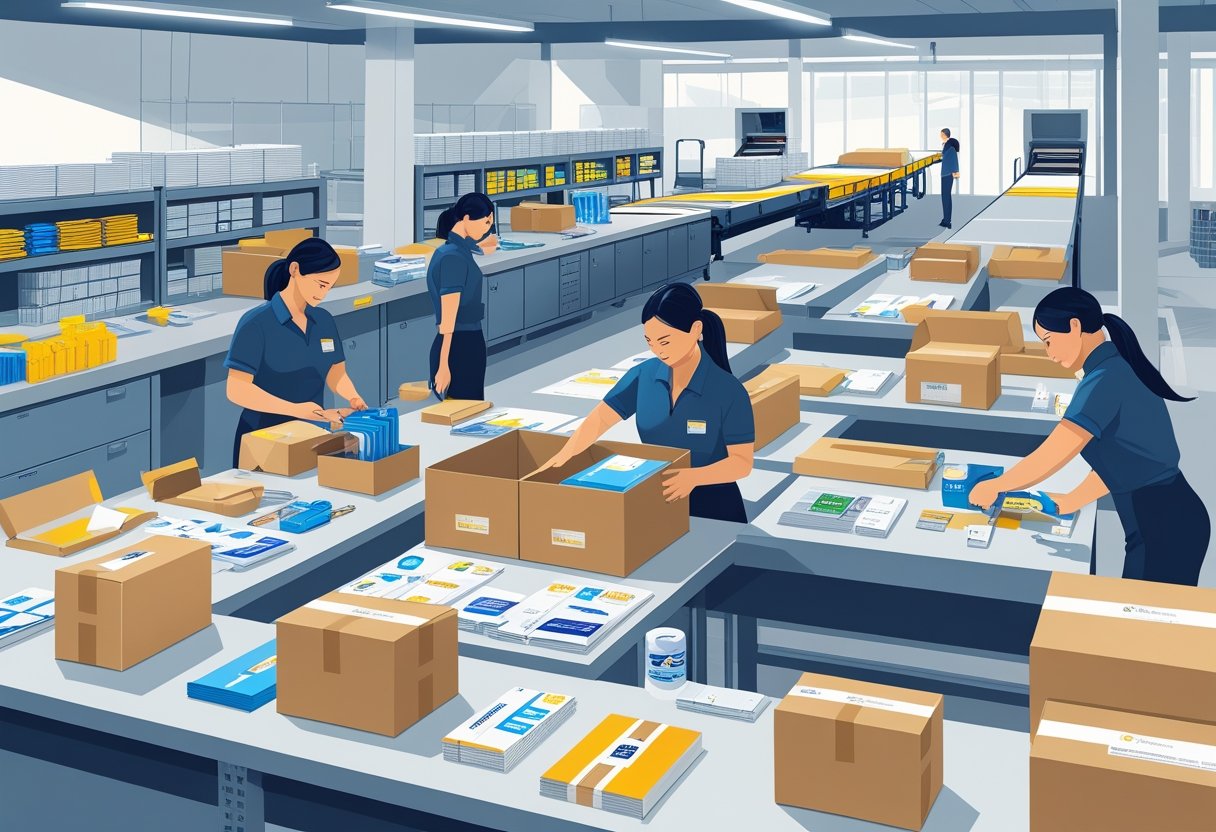
Kitting and assembly is the step where separate printed pieces, samples, and gifts become one package ready to mail. Handing that step to the shop that also runs the mailing removes a vendor handoff, a freight leg, and a place for counts to drift. This page explains how MPA runs kit builds: what we machine-insert, what we hand-assemble, and how every run is counted and reported.
Choosing the right provider matters. MPA has run kitting, assembly, and mailing since 1989, serving businesses in all 50 states from a single Lakeland, Florida facility.
Mail kitting and assembly services build separate components into one finished package that is ready to mail, working from a written specification with counts checked at fixed stages. MPA will kit nearly any combination of components, with food-safety-regulated items and hazardous materials as the only two exclusions, and there is no hard minimum on the assembly work itself: for mailed kits the practical floor is the 200-piece threshold for USPS Marketing Mail presort. Format sets the postage class, because a kit that flexes and stays under 3/4 inch thick rates as a flat while a thicker or rigid kit rates as a parcel, so every quote starts from a physical mockup that is weighed and measured, and every run closes with counts reconciled from receiving report to completed-count report before induction at the USPS BMEU.
Overview of Kitting and Assembly Services for Mailings
Kitting turns a pile of separate components into one finished, mail-ready package, and assembly quality decides whether that package survives the mail stream looking the way you intended. The terms get used loosely, so the distinctions below matter when you scope a job.
What Is Kitting in Mail Fulfillment?
Kitting in mail fulfillment is grouping separate components into a single package built to one written spec, so each recipient gets one piece instead of several loose mailings. The spec fixes what goes in, in what order, and in what outer format before the first kit is assembled.
Difference Between Kitting and Assembly
The terms are often used interchangeably, but they describe different work. Kitting bundles finished items into one package. Assembly changes components before they are packaged: collating pages, folding, or affixing cards and samples to a carrier piece. Most mail programs need some of both, which is why MPA quotes them together from a single kit spec.
▶ Learn about our kit assembly and fulfillment - Learn more about our fulfillment services
Benefits of Kitting and Assembly for Mailings
Three benefits hold up in practice, and each traces to a specific step in how MPA runs the build.
Mail dates hold. MPA pre-builds kits ahead of the drop date to the approved spec, so schedules survive even when components arrive in waves.
Postage and materials stay controlled. Right-sized packaging cuts postage: smaller, lighter kits rate better with USPS, and less void fill means lower material cost per kit.
The recipient sees what you approved. MPA builds kits to the approved sample, so the recipient’s unboxing matches what you signed off.
Types of Kitting and Assembly Services Available
Most kit work MPA quotes falls into one of three shapes.
Custom Kitting Solutions
One-off builds for a launch, an event, or a campaign: a defined component list, a defined outer, and a single mail date. The kit spec is written at setup, a physical sample is approved before production, and the build runs to that sample.
Recurring Program Kitting
Many mailing programs repeat on a schedule: monthly statements with inserts, quarterly member kits, onboarding packets that go out as new customers sign. MPA runs recurring kit builds as standing programs, so each cycle uses the same approved component list, the same quality checks, and the same mail preparation.
- A documented kit spec keeps every cycle consistent.
- Component counts are reconciled against the mailing list before each build.
- The same production team handles every cycle, from component receipt to USPS induction.
Bulk and Batched Assembly Services
High-volume builds where every piece gets identical contents. These are the runs that stay on the machine line: fixed component counts verified batch by batch, in one continuous run from staged stock to finished, addressed mail.
How MPA Runs a Kit Program from Receipt to Induction
Every program follows the same sequence: receive and stage components, build to the spec, verify counts, and mail from the same building.
How MPA Receives and Stages Your Components
You ship components to MPA and we verify them in. Each shipment is checked against the packing list and the job ticket, counted, and logged on a receiving report before anything is staged for assembly.
Components are staged by job rather than mixed into general inventory, so your brochures, samples, and gifts stay dedicated to your campaign. Shortages surface before the build starts, while there is still time to reorder.
Quality Control and Error Prevention
Incoming components are inspected as they are received, and damaged stock is pulled rather than built into kits. Every station works from the written kit spec with count checks between steps; discrepancies are logged and corrected before anything mails.
How MPA Tracks a Kit Order
Each kit program runs against a written spec: component list, insertion order, outer format, and mail class. Counts are reconciled at receiving, at assembly, and at induction.
Labels, facing slips, and postal paperwork generate from the same data file that drives the build, which removes re-keying errors between systems.
Shipping and Distribution Considerations
For kitted mail, distribution is postage strategy. MPA presorts qualifying kit formats in-house and inducts them at the USPS BMEU, so each kit rides commercial rates instead of retail.
Packaging is chosen to protect contents and hold postage down. Every kit leaves with the correct address block and the barcode its format requires: letter and flat formats carry the Intelligent Mail barcode (IMb), and parcel-rated kits carry the Intelligent Mail package barcode (IMpb).
For recurring programs, MPA folds delivery metrics into per-cycle reporting.
Packaging and Storage During a Kit Program
Two practical questions come up on every program: how the kit is packed, and where components live while the program runs.
Packaging Choices That Survive the Mail Stream
Packaging is sized to the components so contents do not shift in transit. Component order, void fill, and closure method are set in the kit spec, not improvised on the line.
Component Storage While Your Program Runs
For recurring programs, MPA stores remaining components between cycles and reports counts after each build, so you know when to replenish. Storage is scoped to active mailing programs rather than general warehousing, which keeps the service focused and the cost predictable.
Choosing the Right Kitting and Assembly Partner
The useful comparison between kitting vendors is not the brochure, it is the paperwork: whether a written spec exists for every build, and whether counts are verified at defined points instead of estimated at the end.
Mail Processing Associates builds kits on the same floor that prints, inserts, and mails them, which keeps accountability with one team. MPA runs fixed-count machine inserting where the components allow it, hand assembly where they do not, and reports completed counts reconciled against your source file at the end of each run.
MPA scopes each kit program to the job at setup and holds that spec for the life of the program, so a seasonal ramp changes the count, not the process.
Kit Configurations MPA Runs
Machine inserting runs at a fixed component count per piece: up to 3 folded 8.5 x 11 sheets or 4 flat inserts into a 6 x 9 outer, fewer into a #10. Recipient-matched kits stay machine-insertable when the outer is a window envelope run in single-program batches; variable counts per piece, or matched components in non-window formats, move to the hand line with marriage-match verification. There is no preset cap on components per kit on the hand line: we have run 18-component builds into 9 x 12 flats.
Every build closes with a completed-count report against your source file, the same discipline MPA has run since 1989 for more than 700 lifetime business customers.
Minimums, Turnaround, and What We Can Kit
There is no hard minimum on kit assembly itself. For mailed kits the practical floor is postal, not mechanical: 200 pieces to qualify for USPS Marketing Mail presort, or 500 pieces for First-Class presort. Kit turnaround is quoted per job from component count and volume once all components are received; recurring kit programs run on fixed weekly or monthly cycles.
MPA kits virtually any component mix: printed pieces, samples, promotional items, and dimensional objects. The only exclusions are items that require food-grade handling and hazardous materials. Weight and size limits follow from USPS rating rather than a house rule; see How Kitted Mail Is Rated by USPS below.
How Kitted Mail Is Rated by USPS
Kit contents determine postage class. A kit that stays under 3/4 inch thick and remains flexible can mail as a USPS flat; thicker or rigid kits are rated as parcels, which changes both the price and the delivery standard. Our assembly and kitting services quote from a physical mockup of the finished kit, weighed and measured before production, so the class you are quoted is the class the finished kit actually rates at.
| Format basis | What qualifies | How it rates |
|---|---|---|
| Letter | No more than 6.125 inches high, 11.5 inches long, and 1/4 inch thick; #10 and 6 x 9 outers typically qualify | Rates as a letter and carries the Intelligent Mail barcode (IMb) |
| Flat | Exceeds a letter dimension but stays within 12 x 15 inches, no more than 3/4 inch thick, and stays flexible | Rates as a flat and carries the IMb |
| Parcel | Thicker than 3/4 inch, rigid, or over flat dimensions | Rates as a parcel and carries the Intelligent Mail package barcode (IMpb) |
Frequently Asked Questions
What are the benefits of outsourcing kitting and assembly services for business mailings?
The benefit we can prove is count control. When MPA runs your kit build, components are verified in on a receiving report, every station works from the written kit spec, and the finished run is reconciled against your source file in a completed-count report.
You also stop staffing assembly internally: our machine line runs fixed-count inserting at production speed, and our hand line covers the recipient-matched and dimensional builds that machines cannot run.
How does the kitting and assembly process enhance the efficiency of sending out bulk mailings?
The efficiency is in running the whole job as one pass. MPA machine-inserts fixed-count kits, up to 4 flat inserts or 3 folded sheets into a 6 x 9 outer, then presorts the finished mail and inducts it at the USPS BMEU.
Counts are reconciled at three points, receiving, assembly, and induction, so a bulk run does not need a recount after the fact to find shortages.
What should I consider when choosing a company to handle kitting and assembly for my mailing needs?
Judge the paperwork, not the pitch. The two documents that predict a clean program are a written kit spec and a count report; if a provider cannot produce either from a current job, the counts on your job will be estimates.
Ask any provider to walk you through a live kit spec and a completed-count report; MPA shares both during scoping.
What is the difference between kitting services and product assembly companies?
Kitting for mail is postal work. The kit spec MPA writes ties the component list to an outer format and a mail class, and the finished kits leave as addressed, presorted USPS mail carrying the barcode their format requires.
Product assembly companies build finished goods for retail or warehouse distribution, and the work ends at a pallet rather than a mail stream. If your kits need to reach a mailbox, scope the job with a provider that prepares postal paperwork every day.
How do kitting and assembly services manage large-scale promotional mailings for businesses?
At MPA, scale is managed by staging and batch verification. Your components are staged by job so they never mix into general stock, machine batches are count-checked as they run, and recipient-matched builds carry marriage-match verification on the hand line.
When components arrive in waves, we pre-build finished kits to the approved sample ahead of the drop date, which is how large campaigns hold their mail dates.
What kind of items are typically included in kitting services for direct mail campaigns?
Brochures, coupons, samples, promotional gifts, and dimensional objects all run through the same spec-and-count process at MPA. We kit almost anything a mail piece can carry; the two exclusions are items that need food-grade handling and hazardous materials.
Contents decide the postage: a finished kit under 3/4 inch thick that still flexes mails as a flat, and anything thicker or rigid rates as a parcel, which is why we weigh and measure a mockup before we quote.