B2B Direct Mail Marketing: The 2026 Playbook for Reaching Decision-Makers
Most B2B marketers stopped thinking about print a decade ago. The teams closing enterprise deals did not. A senior decision-maker works through an inbox commonly reported at 120 or more messages a day, and a stack of desk mail that rarely reaches five pieces. That ratio is the entire argument for the channel.
Physical mail is not a nostalgia play in a B2B motion. It is the one outbound touch that cannot be filtered, muted, or auto-archived before a human sees it. The question is not whether it reaches the desk. It is whether the piece that lands there is worth what you spent putting it in the mailstream.
This guide covers what B2B direct mail marketing actually costs in 2026, what response rates are defensible, how to build the list and the sequence, and how to measure the result well enough to defend the budget line. Postage figures are current to the USPS price change effective July 12, 2026.
Ready to price a campaign? Get a quote from our team or call 863-687-6945. We handle list processing, printing, addressing, and postal entry in-house from Lakeland, Florida.
What is B2B direct mail marketing?
B2B direct mail marketing is targeted print outreach sent to named business decision-makers at their place of work, built to open and advance accounts through a sales cycle that usually runs 3 to 12 months. It differs from consumer mail in three ways that matter operationally: it targets a buying committee rather than one person, it carries a much higher per-piece budget because the deal behind it is worth more, and it is measured on meetings and pipeline rather than on immediate redemption. The industry benchmark most often quoted for average B2B direct mail response is 4.4%, and formats range from a 6x9 postcard at roughly $0.30 to $0.65 in production cost to a dimensional mailer at $4.50 to $24.00 per piece before postage.
What Makes B2B Direct Mail Different from B2C
The two share a delivery network and almost nothing else. Treating a B2B campaign like a consumer campaign is the most reliable way to waste the budget.
You Are Mailing a Committee, Not a Person
A consumer campaign targets the individual who makes the purchase. A B2B campaign targets a group. Enterprise buying decisions typically involve six to ten people across departments, each evaluating a different part of the decision.
That changes the list. You are not renting a geographic radius. You are assembling named contacts at named companies, then verifying those people still hold those roles.
The Sales Cycle Absorbs the Touch
Consumer mail usually asks for an immediate action. Business mail is one touchpoint inside a months-long evaluation, and its job is frequently narrower than a conversion.
A B2B piece succeeds when it earns a meeting, triggers a demo request, or keeps you in consideration while a committee works through procurement. Judging it on same-week revenue will make a working campaign look like a failure.
Higher Spend Per Piece, Higher Value Behind It
Enterprise deal sizes justify spend that would be irrational in consumer mail. A dimensional mailer costing $12.50 all-in is trivial against a $50,000 contract, so B2B pieces skew toward heavier stock, deeper personalization, and formats that demand to be opened.
The discipline is matching spend to deal value, not maximizing it. That same $12.50 package sent to 5,000 unqualified contacts is a $62,500 mistake. Sent to 250 researched accounts it costs $3,125, which is a rounding error against the pipeline it can open.
Office Delivery Changes the Physics
Business mail arrives at a front desk, not a home mailbox. It is frequently screened before the addressee touches it, which penalizes anything that looks like an advertisement.
Dimensional mail clears that filter because it reads as a delivery. Flat mail has to earn the open on the outer envelope alone, which is why the envelope deserves as much attention as the letter inside it.
B2B Direct Mail Response Rates and Benchmarks
Response benchmarks get quoted carelessly, most often by setting a mail response rate beside an advertising click-through rate as though the two measured the same thing. They do not. The table below compares response to response only.
| Channel | Typical response rate |
|---|---|
| Direct mail, most-quoted benchmark | 4.4% |
| Cold prospect email | 0.12% |
Three caveats belong with that table, and they matter more than the numbers do. The 4.4% figure is the benchmark that circulates most widely for direct mail generally; it is not segmented to B2B, and anyone presenting it as a B2B-specific number is overstating what the underlying reporting supports. The email figure is cold-list only, while house-list email commonly runs nearer 1%. And a response is not a sale. It is a raised hand a salesperson still has to convert.
Segment-level B2B benchmarks are genuinely thin, which is the honest answer to "what response rate will I get." The variables that move a B2B result are list accuracy, how many of the buying committee you reach, and whether sales follows up inside the delivery window. Those are all things you control, and none of them are captured by an industry average.
We have also left cost per lead out of that table on purpose. The ranges published for it are uncited and vary by an order of magnitude across sources. The cost-per-response section below derives the figure from this page's own cost inputs instead, so you can check the arithmetic rather than trust it.
Deliberately absent from that table: paid search, social, and display click-through rates. A click and a mailed reply are not comparable units, and stacking them side by side is how direct mail ends up looking a hundred times better than it honestly is.
B2B direct mail marketing also performs better inside a sequence than on its own. Mail landing two to three days ahead of a rep's call, with the digital touches timed around it, outperforms the same piece sent in isolation, because the rep has something concrete to reference on the phone.
What B2B Direct Mail Marketing Costs in 2026
Cost has two independent halves: producing the piece, and paying USPS to move it. Quoting them as one blended number is how budgets get built wrong, so they are separated here.
Production Cost by Format
These ranges cover printing, data processing, addressing, and finishing. Postage is additional and handled in the next section. Ranges narrow at higher quantities.
| Format | Production cost per piece | Best use case | Typical B2B response rate |
|---|---|---|---|
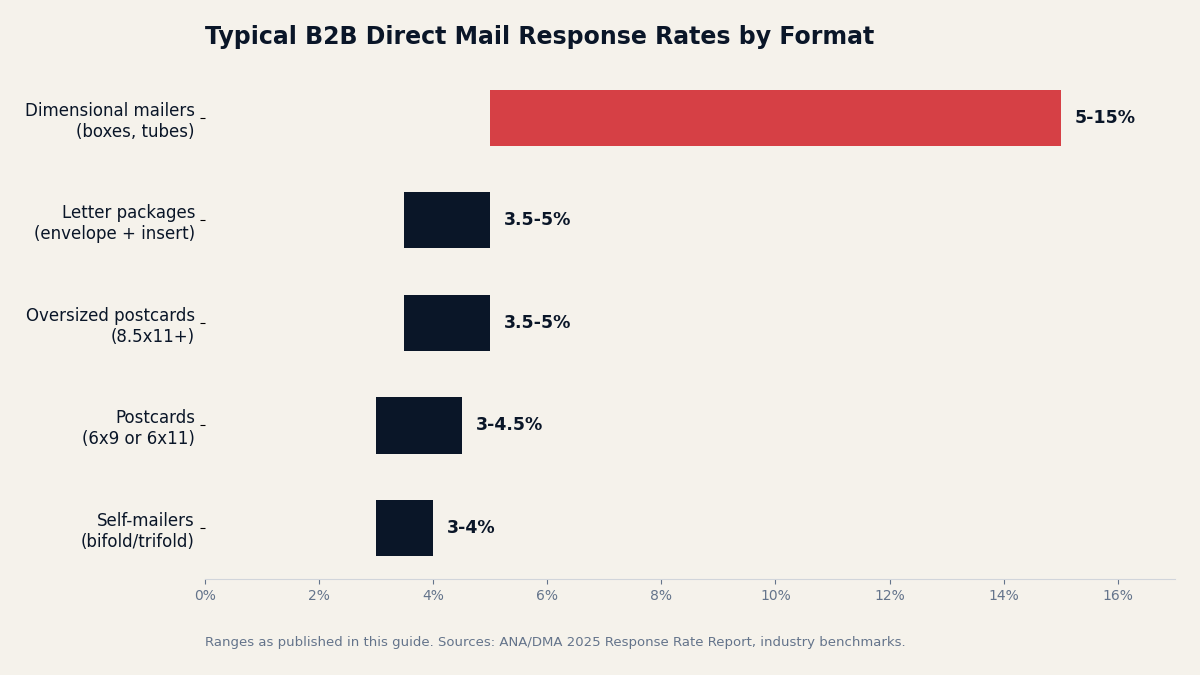
| 6x9 postcard | $0.30 to $0.65 | Awareness, event invitations, simple offers | 3.0% to 4.5% |
| 6.25x11 jumbo postcard | $0.45 to $0.90 | High-impact visuals, brand awareness | 3.5% to 5.0% |
| Self-mailer, bifold or trifold | $0.55 to $1.60 | Product overviews, service menus | 3.0% to 4.0% |
| Letter package, envelope plus letter plus insert | $0.85 to $2.40 | Detailed offers, case studies, proposals | 3.5% to 5.0% |
| Dimensional mailer, box or tube | $4.50 to $24.00 | Account-based and C-suite outreach | 5.0% to 15.0% |
Postage by Mail Class
Every figure below is the Mixed presort tier from USPS Notice 123 effective July 12, 2026, which is the tier most B2B lists actually qualify for. Tighter presort depth earns lower rates, but a business list scattered across the country will not reach them, so Mixed is the honest number to budget against.
| Mail class, Mixed presort tier | Rate per piece | Best for |
|---|---|---|
| Marketing Mail Letter Presort Mixed AADC | $0.467 | Bulk B2B letter campaigns, 200 pieces or more |
| FCM Presort Letter Mixed AADC | $0.707 | Time-sensitive letters, forwarding and return service; presort pricing needs 500 pieces |
| FCM Presort Postcard Mixed AADC | $0.495 | Card-size pieces only, up to 4.25 x 6 inches |
Two size thresholds decide which of those rates you actually get, and both routinely wreck budgets.
The card rate applies only to pieces no larger than 4.25 x 6 inches. A 6x9 postcard is not a card to USPS, it is a letter, and it pays letter postage. Budgeting a 6x9 at the card rate understates postage on the cheapest format most B2B teams reach for.
The letter maximum is 6.125 inches high by 11.5 inches long by 0.25 inches thick. Anything larger is a flat, and flats cost materially more than letters. That is why the 6.25x11 jumbo postcard in the format table above is a flat, not a letter: it clears the height limit by an eighth of an inch. Flat rates are not shown here because they vary with shape and weight, so ask for them per job rather than assuming the letter rate carries over. If postage is the binding constraint, a 6x9 keeps you in letter rates while a 6.25x11 does not.
Marketing Mail requires a minimum of 200 pieces and USPS-compliant preparation, including presort, barcoding, and address standardization. Rates are published by USPS in Notice 123, the DMM price list. We hold a USPS Business Mail Entry Unit permit, presort in-house, and induct our own mail directly at the BMEU, so the discount work happens as part of the job rather than as a line item you manage.
What It Adds Up To
A realistic mid-market campaign: 1,000 letter packages, each a #10 envelope with a personalized letter and a one-page insert.
- Production at $1.60 per piece: $1,600
- Marketing Mail letter postage at $0.467 per piece: $467
- All-in: $2.067 per piece, or $2,067 for the drop
Cost per Response by Format
The useful comparison is not cost per piece. It is cost per raised hand, which reorders the formats considerably. Every letter-size format below carries Marketing Mail letter postage of $0.467 per piece, because a 6x9 postcard, a letter-size self-mailer, and a #10 letter package all mail at letter rates. The 6.25x11 jumbo is deliberately absent: it is a flat, and pricing it here at the letter rate is exactly the error the section above warns about. The response rate applied to each row is printed in the table and sits inside that format's range from the production table above.
| Format | All-in cost per piece | Pieces mailed | Responses | Cost per response |
|---|---|---|---|---|
| 6x9 postcard | $0.95 | 1,000 | 35 at 3.5% | $27.14 |
| Self-mailer | $1.54 | 1,000 | 35 at 3.5% | $44.00 |
| Letter package | $2.067 | 1,000 | 44 at 4.4% | $46.98 |
| Dimensional mailer | $12.50 plus parcel postage | 250 | 20 at 8.0% | $156.25 |
Postcards win on cost per piece and lose the argument anyway. Letter packages cost more than twice as much per piece yet land within about $20 of a postcard on cost per response, because they convert at a materially higher rate. Dimensional mail costs roughly three times more per response and is still the right call when the accounts behind it are worth six figures. Dimensional pieces are parcel-rated rather than letter-rated, and postage moves with weight and dimensions, so treat the $12.50 as a planning figure and quote it per job.
How to Build a B2B Direct Mail Marketing Campaign
The order below is deliberate. List work comes first because it is the only step whose failures are invisible until postage is already spent, and tracking comes last only in sequence, not in importance: it is the step teams skip and then cannot justify a second campaign without.
Step 1: Build the Target Account List
The list determines more of your result than the creative does. A usable B2B list is filtered on two levels at once.
Company-level filters cover industry, revenue band, employee count, geography, and technology in use. Contact-level filters cover job title, department, seniority, and whether the person actually holds budget authority.
Start inside your own CRM. Existing customers and open opportunities are the highest-responding segment you will ever mail, and they cost nothing to source. Build outward from there using firmographic data providers, then run the combined file through address validation and change-of-address updates before anything prints.
Our mailing list services cover list cleaning, deduplication, change-of-address updates, and merge and purge processing. Skipping that step means paying full postage to mail people who left the company.
Step 2: Match Format to Objective
Format should follow the campaign goal and the seniority of the target, not the budget you happen to have.
Awareness campaigns across a wide list run on postcards or self-mailers. They are inexpensive, they need no envelope, and the message lands without requiring the recipient to open anything.
Lead generation to a mid-funnel list runs on letter packages. The envelope buys room for a real value proposition, a case-study excerpt, and a reply device.
Account-based outreach to executives runs on dimensional mail. A branded box with something useful inside gets opened and gets remembered, which is exactly what you are buying at that price point.
Step 3: Write for a Five-Second Read
In B2B the piece is usually triaged by someone who is not the addressee, so it has to survive two readers: the person sorting the mail at the front desk, and the executive it was meant for. That argues for a specific outcome set in the largest type on the piece. "Cut procurement costs 30% in 90 days" reads as business correspondence and gets carried down the hall. "Your Trusted Procurement Partner" reads as advertising and gets sorted accordingly.
Give one call to action, not four. One phone number, one URL, or one code to scan. Every additional option lowers the odds any of them get used, and it splinters your tracking across response devices you then cannot compare against each other.
Credentials carry more weight in B2B than in consumer mail, because the recipient is buying on behalf of an employer and has to defend the choice internally. If your compliance posture matters to that buyer, put it where it is readable without opening anything. On the pieces we produce for regulated industries, that is usually one short line on the outer envelope rather than a paragraph on page two.
Step 4: Personalize Past the First Name
Merging a name and company is table stakes and no longer moves response. The personalization that changes outcomes is contextual.
Industry-specific messaging beats generic business language: a piece going to healthcare marketers should talk about patient communications and enrollment windows, not "business growth." Trigger-based timing beats calendar timing: mail the week a company announces funding, opens a location, or posts a role that signals the problem you solve. Account-specific references beat both, because they prove a human looked at the account.
Variable data printing is what makes that operationally possible. Every piece in a run can carry different copy blocks, images, and offers without a second press setup.
Step 5: Build Tracking into the Piece
An untracked mail campaign cannot be defended at budget time, and it will not be renewed. Put at least one measurable response device on every piece, and decide which one before the file goes to press rather than after.
- Personalized URLs. A unique address per recipient identifies the account without asking the visitor to self-identify. It requires a variable field in the data file, so it has to be specified before the list is finalized, not bolted on at proof stage.
- QR codes. The cheapest device to add and the easiest to ruin. Keep the quiet zone clear, avoid placing a code across a fold or inside the address block clear zone, and carry UTM parameters in the target URL.
- Unique phone numbers. The only device that captures the buyer who reads the piece and picks up the phone without ever touching a browser, which in B2B is a meaningful share of responders.
- Offer codes. Cheap, but they only fire at purchase, so they miss every response that stops at a conversation.
- USPS Informed Delivery. The daily digest email USPS sends recipients can carry a clickable image of your piece. It is a genuine second impression at no extra postage, and it has to be submitted as part of the mailing, not afterward.
Account-Based Direct Mail as a Managed Service
Account-based marketing is where physical mail earns its highest return. Rather than mailing a broad list, you mail a small set of high-value accounts and the buying committee inside each one, timed against what sales is already doing.
The hard part is rarely the creative. It is the orchestration: pulling the right accounts out of the CRM, firing mail at the right moment in the cycle, personalizing from live account data, and keeping all of it synchronized with the sales team. That operational load is where most in-house programs stall.
We run account-based mail as a fully managed service. We connect directly to your HubSpot, Salesforce, Marketo, or other CRM and operate the program on your behalf, so nobody on your team is exporting lists by hand.
- Named accounts and full committees. We pull your target account list from your CRM and mail the relevant titles at each company, so the whole committee sees a consistent message rather than one contact receiving it in isolation.
- Triggered sequencing. Mailings fire on the signals you choose: a stage change, a new lead, a renewal window, a closed-lost reactivation. Each physical touch is timed to land alongside your digital activity.
- Personalization from live CRM fields. Company name, industry, territory rep, and the relevant offer render through variable data printing in a single production run.
- One team, all 50 states. Data processing, printing, personalization, and mailing happen under one roof at our Lakeland facility, on one schedule, with one point of accountability.
Talk to our team about connecting your CRM and running a managed account-based program.
Measuring B2B Direct Mail ROI
Most B2B direct mail marketing campaigns are not underperforming. They are under-measured, and the two look identical in a quarterly review.
The Formula and a Worked Example
ROI = (revenue attributed to the campaign minus total campaign cost) divided by total campaign cost, times 100.
Using the 1,000-piece letter package campaign costed above:
- Campaign cost: $2,067 all-in
- Response at 4.4%: 44 responses
- Meeting conversion at 25%: 11 meetings
- Close rate at 20%: 2 new customers
- Average deal size: $25,000
- Revenue: $50,000
- ROI: $47,933 divided by $2,067, or about 2,319%
Those conversion assumptions are the part to argue with. Substitute your own close rate and average deal size before taking the number to a CFO, because a campaign that pencils at 2,319% on borrowed assumptions pencils very differently on yours. Our direct mail ROI benchmarks give ranges by industry to sanity-check the inputs.
Attribution Methods That Hold Up
Campaign codes in the CRM. Tag every mailed contact before the drop. When they respond through any channel, the CRM can attribute it back.
Multi-touch attribution. B2B buyers touch many channels before purchasing, and mail is rarely the last one. Last-touch reporting will systematically undercount it.
Holdout testing. Mail a test group, withhold a comparable control group, and compare conversion. This is the cleanest read on incremental impact available, and it costs nothing but discipline.
Matchback analysis. After the campaign window closes, match your buyer list against your mail file. Buyers who received mail but never used a tracking device still represent attributable lift.
Five Mistakes That Kill B2B Direct Mail Marketing Campaigns
Mailing a stale file. B2B contact data decays quickly because people change roles constantly. A list that was clean a year ago is not clean now, and every dead record costs full postage for zero chance of response. Run address validation and change-of-address updates before every drop, not once a year.
Running a consumer playbook. Volume and broad targeting work in consumer mail. Blanketing every business in a ZIP code is that strategy misapplied, and it buys reach you have no intention of selling to.
No follow-up plan. Mail opens the door. If nobody calls within three to five days of in-home delivery, the investment expires unused. Book the follow-up window on the sales calendar before the job goes to press.
Skipping the test. Do not put the full budget behind one untested concept. The catch in B2B is that target lists are usually too small for a clean read on creative, so test the variables that move results most at low volume: the offer and the format. Save headline and layout tests for the campaigns where you are mailing enough accounts to tell a real difference from noise.
Ignoring postal optimization. Presort depth, automation compatibility, and mail class selection materially change what a drop costs. Choosing First-Class where Marketing Mail would serve is a self-inflicted expense on every piece.
Why Work With Mail Processing Associates
We have been printing and mailing since 1989, which puts 35 years of production history behind every job. We serve more than 700 lifetime business customers in all 50 states from a single Lakeland, Florida production facility, and we hold 5.0 stars across 100+ verified Google reviews.
We run B2B direct mail marketing end to end under one roof: data processing, printing on our Xerox Iridesse and Versant presses, variable data personalization, inserting, and postal entry through our own BMEU permit. Most First-Class jobs turn in 3 to 5 business days. One team owns the job from file receipt to induction, which means no handoff between vendors and one number to call when a deadline moves.
See our B2B direct mail services for vertical detail, or our direct mail services overview for the full production picture.
Frequently Asked Questions About B2B Direct Mail
Does B2B direct mail marketing still work in 2026?
Yes, and the case is stronger than it was five years ago. B2B direct mail marketing works precisely because inbox competition has intensified while physical mail volume to the desk has not. The channel is not a replacement for digital outreach; it is the touch that gets a reply when digital alone has stopped producing one.
What response rate should I expect from B2B direct mail?
The benchmark quoted most often across industry reporting is 4.4%. House-list mailings to existing customers and open opportunities run higher than cold prospect lists, and dimensional mailers to a tightly researched account list commonly outperform both. Your actual result depends on list quality, offer relevance, and format, so treat any published benchmark as a planning figure rather than a forecast.
How much does a B2B direct mail campaign cost?
Production runs roughly $0.30 to $0.65 per piece for a 6x9 postcard and $0.85 to $2.40 for a letter package, with dimensional mail from $4.50 to $24.00. Postage is separate. A 1,000-piece letter package campaign at $1.60 production plus Mixed-tier Marketing Mail postage lands at $2.067 per piece, or $2,067 for the drop.
What postage class should a B2B campaign use?
Marketing Mail is the default for any mailing of 200 pieces or more that is not time-critical, and Marketing Mail letter postage is $0.467 per piece. Use First-Class when delivery timing matters or when you need forwarding and return service, because FCM Presort Letter Mixed AADC is $0.707 per piece. First-Class presort pricing requires 500 pieces, so a 200-to-499-piece job either rides Marketing Mail or pays the $0.82 single-piece rate. The gap is about $0.24 per piece, so on 10,000 letters the class decision is worth roughly $2,400.
Which mail format works best for B2B?
It depends on the goal. Postcards are efficient for awareness and event invitations, letter packages carry detailed offers and generally deliver the best balance of cost and response, and dimensional mailers produce the highest response rates and suit account-based outreach to executives. For a typical mid-funnel B2B campaign, the letter package is the default.
How do I build a mailing list for B2B direct mail?
Start with your CRM, because existing customers and open opportunities respond at the highest rate of any segment you can mail, then expand with firmographic data filtered on industry, company size, revenue, geography, and job title. The step most teams miss is deduplicating at the right level: mailing four people at one company is intentional in an account-based program and wasteful in a broad campaign, so decide which you are running before you dedupe. Suite and floor numbers are also the most common defect in purchased B2B data, and a missing suite on a multi-tenant building is frequently undeliverable even when the street address validates.
How do I track B2B direct mail results?
Tag the contacts in your CRM before the drop, not after, because retrofitting attribution to a list you already mailed is guesswork. Set the measurement window to your actual sales cycle: a 30-day window on a channel with a 3 to 12 month cycle will report failure on a campaign that worked. Expect a delivery spread of several days rather than a single arrival date, so anchor the window to in-home dates rather than to the day the job mailed.
Can direct mail be integrated with digital campaigns?
Yes, and it works better that way. The common pattern is a digital impression first, the mail piece landing a few days later, a follow-up email referencing the piece, and retargeting that reinforces it. Coordinating that sequence is what turns a single mailer into a campaign, and it is the part we operate for clients running account-based programs.
"The single most-overlooked variable in direct-mail performance isn't creative or list quality. It's USPS handoff timing. Get that wrong and your response window collapses by two weeks."
Alec Boye, President, Mail Processing Associates